· Rajat Pandit · AI Engineering · 8 min read
Structured Agent Memory vs Vector Search
Pinecone's Nexus Engine compiles business context into structured knowledge graphs for agents. Nemotron 3 Embed tops RTEB. Vector search alone is now insufficient. Here is the memory architecture shift every AI team needs to understand.
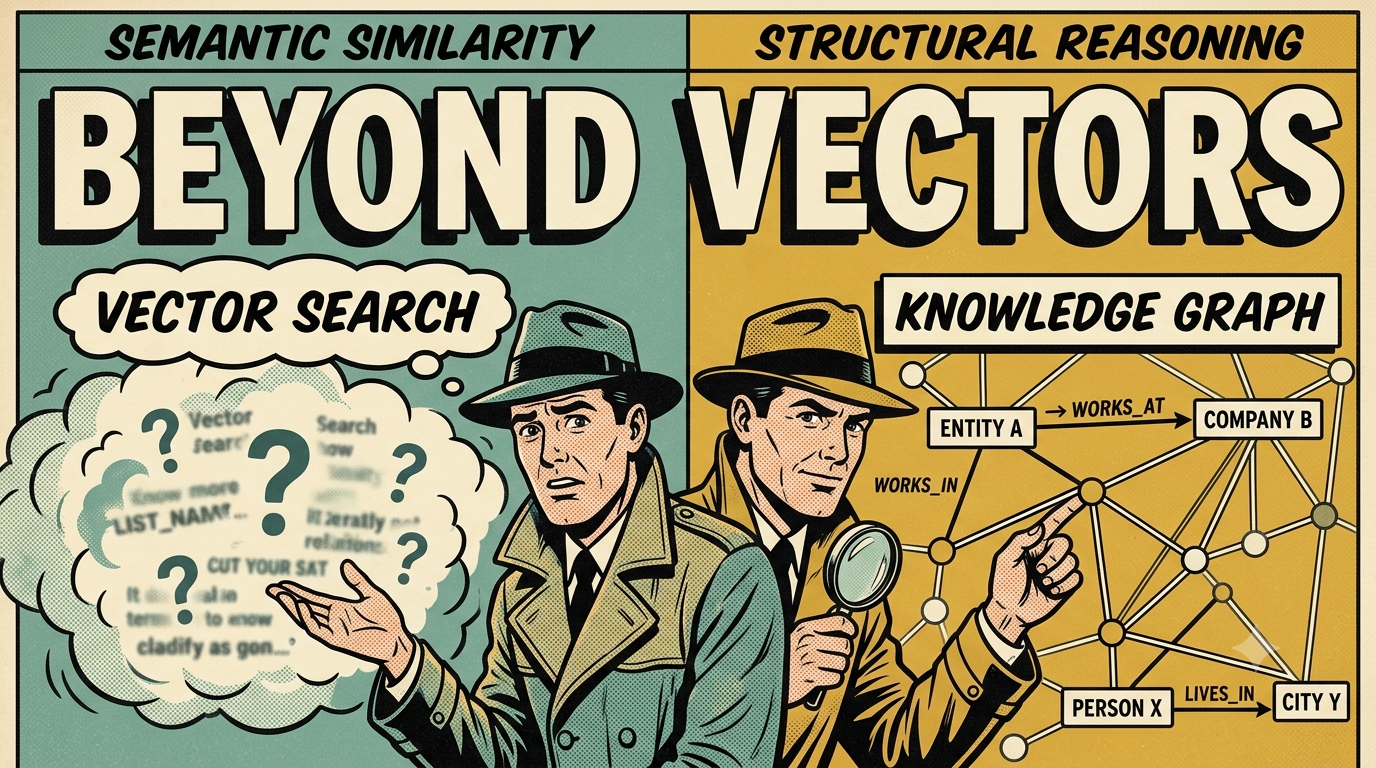
Vector search for AI applications has been the default retrieval architecture for three years. You embed text, store vectors in a database, query with similarity search, and return the top-k results to your language model. This approach works. It works well for simple retrieval-augmented generation tasks where the question is semantically close to the stored text.
But agents are not simple retrieval systems. They are autonomous reasoning loops that need context about entities, relationships, constraints, and causal chains. An agent that only receives embedding-similar text chunks is making decisions based on the most similar text, not necessarily the most relevant facts.
The Pinecone Nexus Engine announcement from late July is a signal of a deeper shift. It compiles unstructured business context into structured knowledge graphs optimized for agent consumption. Combined with NVIDIA’s Nemotron 3 Embed topping the RTEB benchmark, this is a two-signal confirmation that vector search alone is hitting its limits.
The industry is moving from similarity-based retrieval to structure-based reasoning. Here is why that matters and what it changes.
- Vector search provides semantic similarity but cannot answer multi-hop structural questions that agents need for decision-making.
- Knowledge graphs represent entities and relationships explicitly, enabling agents to query structural facts that vector search cannot retrieve.
- The RTEB benchmark signals that agentic retrieval requires structured knowledge, not just embedding similarity.
- The cost model shifts from many cheap queries with poor retrieval to fewer expensive queries with rich, accurate results.
The Limits of Vector Retrieval for Agents
Vector search works by finding documents or text chunks whose embeddings are closest to the query embedding in vector space. This is effective when the answer to a question is contained in text that is semantically similar to the question itself. Ask about the features of a product, and vector search returns text chunks describing those features. Ask for the latest pricing tier, and vector search returns the pricing paragraph that is most similar to your query.
This works for document retrieval. It does not work for multi-hop reasoning.
Consider an agent that needs to answer: “If we upgrade the production database from PostgreSQL 14 to 16, which microservices need code changes?” A vector search approach would find text chunks about database versions or microservice details, but it would not connect the dots between the database dependency graph, the code that queries that database, and the API contracts between services. The answer requires structural knowledge about how systems are connected, not textual similarity.
An agent that receives only vector-similar text chunks would need to be clever enough to ask multiple questions, piece together the results, and infer the connections. Most agents are not clever enough for this. They ask one question, receive one chunk, and produce an answer that is incomplete or wrong.
The problem is not the agent’s reasoning ability. The problem is the retrieval architecture. Vector search provides similarity. Agents need structure.
What Knowledge Graphs Give Agents That Vectors Do Not
A knowledge graph represents entities and their relationships in a structured, queryable format. Instead of storing text and finding similar text, you store facts and query relationships.
For an agent working with business data, a knowledge graph might represent:
- Entities: databases, microservices, APIs, teams, deployment environments
- Relationships: “Service A depends on Database B”, “Team C owns Service D”, “API E requires authentication method F”
- Attributes: database version, service health status, deployment region, API rate limit
An agent querying this graph can ask structural questions that are impossible with vector search: “Show me all services that depend on the production database.” “Which team owns the services that would break if we change the database version?” “What authentication methods are used by services that connect to the database?”
These are not semantic similarity queries. These are structural relationship queries. And they are exactly the questions agents need to answer when making decisions about infrastructure changes, code refactoring, and system architecture.
The RTEB benchmark that Nemotron 3 Embed topped measures retrieval quality for agentic workflows. Vector-only retrieval scores adequately on simple semantic matching. Structured retrieval with entity resolution and relationship tracing scores significantly higher because it returns facts with contextual relationships, not just similar text. This is not a marginal improvement. It is a qualitative leap in retrieval quality for agentic tasks.
The Architecture Shift: From Embedding Cache to Entity Graph
Building a knowledge graph for agent consumption is an engineering challenge that most teams have not solved. The process involves:
Extracting entities from unstructured text. Business documentation, runbooks, architecture diagrams, ticket systems, and code comments all contain facts about systems and processes, but they are embedded in natural language that requires parsing and extraction to become structured data. This extraction is not trivial. Entity extraction accuracy depends on the quality of the extraction model and the diversity of the documentation it was trained on.
Mapping relationships between entities. Once you have entities, the next step is identifying the relationships that connect them. An architecture diagram in a PDF describes connections between services. A runbook describes how one system depends on another. A code comment explains why a particular API contract exists. All of these are relationship data that needs to be extracted and structured.
Maintaining graph freshness. Knowledge graphs must reflect the current state of your systems. When a service changes, when a team restructures, when an API contract updates, the graph needs to be updated. This requires continuous monitoring and incremental graph updates, not a one-time extraction process.
The teams that build these pipelines well treat the knowledge graph as a living data structure, continuously updated from multiple sources, with quality checks that validate entity accuracy and relationship completeness before agents consume the data.
Performance and Cost Implications
The shift from vector search to structured knowledge graphs has measurable performance and cost implications.
Vector search is fast and cheap for simple queries. A similarity search against billions of embeddings takes milliseconds and costs fractions of a cent per query. Knowledge graph queries are more computationally expensive. Traversing relationships, resolving entity links, and filtering by attributes takes more compute than a single vector similarity calculation.
But the accuracy improvement justifies the cost for complex queries. When vector search requires three or four follow-up queries to piece together an answer, the total cost and latency exceed a single graph query that returns the complete answer. For agents that execute autonomously, each unnecessary query adds latency, burn, and potential error propagation.
The cost model shifts from expensive queries with simple retrieval to efficient queries with rich retrieval. One structured query returns more accurate, more complete information than three vector queries that each return a partial answer.
For production systems, especially production agent systems that execute hundreds of retrieval calls per task, this shift compounds quickly. A 50 percent reduction in queries per task through better retrieval architecture translates directly to lower inference cost, lower latency, and simpler agent reasoning loops.
The Real-World Impact on Agent Behavior
When agents receive structured knowledge instead of raw text, their behavior changes in three measurable ways:
Accuracy improves on multi-hop questions. Agents that reason over structured data produce correct answers to questions that require connecting facts across multiple domains. An agent that knows the relationship between your database, your services, and your team structure can answer operational questions that vector search completely misses.
Hallucination decreases. When an agent has access to structured factual data instead of guessing from contextual text, it has fewer reasons to fabricate connections or invent details. The structured graph provides a reference that the agent can verify against. If the graph says Team A owns Service B, the agent can state that as a fact rather than inferring it from ambiguous documentation.
Confidence in autonomous execution increases. Agents that operate with accurate structural knowledge make fewer errors in decisions that affect actual systems. When an agent proposes a database migration plan, the plan is based on known service dependencies, not inferred assumptions about code structure. This directly translates to fewer broken deployments and faster autonomous execution.
The Path to Structured Agent Memory
Building a production-grade knowledge graph for agent consumption is not a weekend project. It requires continuous extraction pipelines, quality validation processes, and ongoing maintenance as your systems evolve. The investment is substantial. But the return on investment compounds as agents grow more autonomous and the structural knowledge they depend on becomes more critical to system reliability.
The teams starting this process today should focus on the highest-impact domain first. Not all knowledge is equally valuable for agent decision-making. The knowledge that connects your infrastructure systems, your service dependencies, and your operational procedures has the highest leverage. Start there, prove the model with a subset of your systems, and expand from a proven foundation.
Vector search is not going away. Simple semantic retrieval tasks still deserve simple retrieval solutions. But for the agents that are building the future of autonomous AI systems, vector search alone is insufficient. The agents that succeed are the ones that receive structured knowledge about the systems they operate, and that knowledge is fundamentally different from what vector search provides.
The architecture shift is underway. The tools are emerging. The teams that make the transition first will have agents that operate with accuracy and confidence that vector-only retrieval systems cannot match.