· AI Infrastructure · 10 min read
The AI Capital Wall: Why GPUs Are No Longer the Scarcest Resource
AI capital wall analysis: GPUs are no longer the scarcest resource. Data center capacity, liquid cooling, and power density are the real bottlenecks for scaling AI infrastructure in 2026.
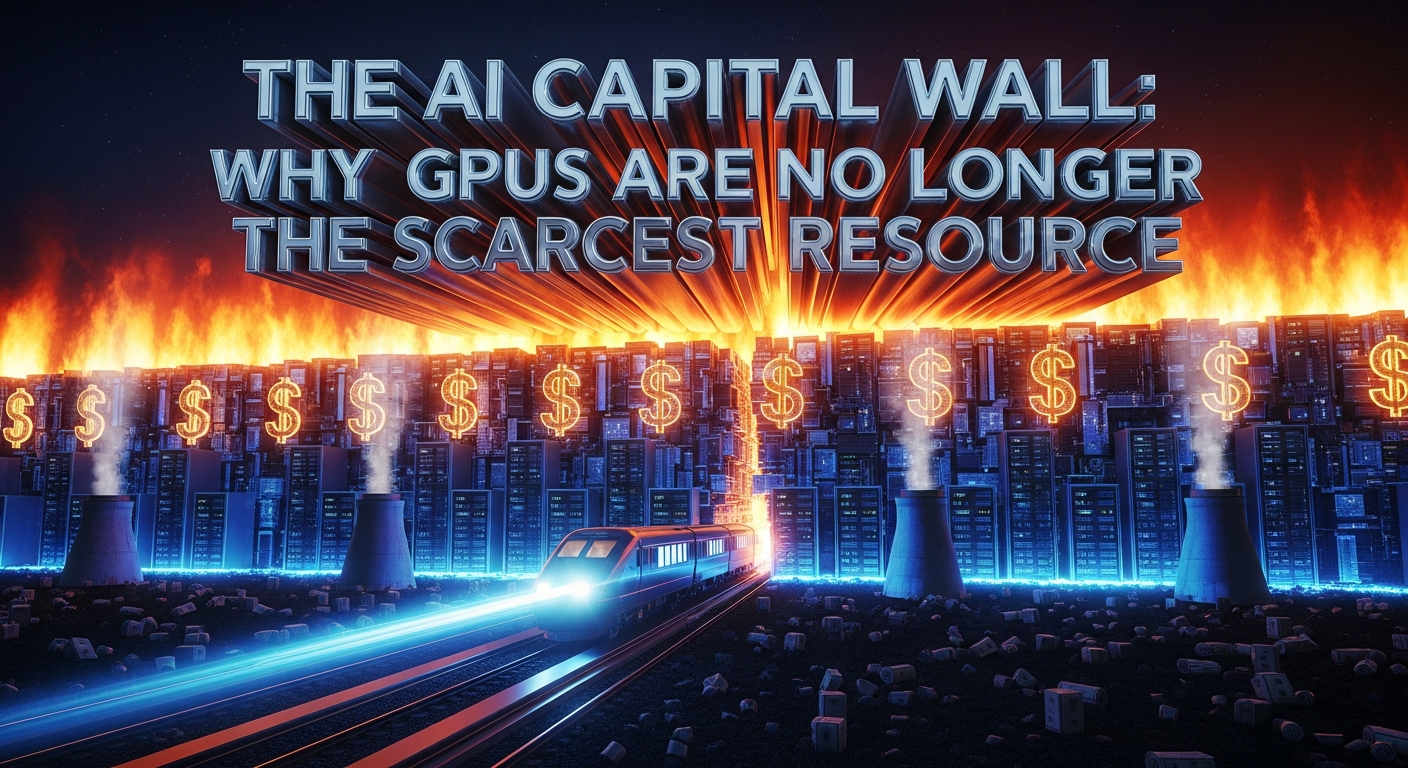
- Every AI engineer and data center operator will tell you the same thing. The hardest bottleneck is no longer GPUs. It is something nobody predicted in 2023.
- Data center power capacity has become the limiting factor for scaling AI clusters, not GPU supply.
- Liquid cooling is the new bottleneck that emerges once power capacity is solved.
- The organizations building winning infrastructure strategies in 2026 are those that treat power and cooling as their primary constraints, not their GPU procurement team.
Let me tell you the strangest thing I have heard from a data center operator in the past six months.
A team with $400 million in GPU procurement ready to ship arrived at a contracted data center only to find they could not power them. The facility had the racks, the network connections, the physical space. But every outlet was full. The power grid connection was maxed out. There was simply no electricity available for the new racks.
The GPUs were sitting in a container at the port. The money was spent. The team had nowhere to put them.
This is not an edge case. The same story plays out on different scales everywhere you look.
The constraint that limits AI infrastructure growth has shifted from hardware to utilities.
The GPU Illusion
Think back to 2023. If you walked into any AI startup and asked what was holding them back from scaling, they would say GPUs. They were impossible to source. NVIDIA would allocate you 400 H100s or maybe 800 if you had a good relationship with your account manager. The procurement cycle took weeks. The price was inflated. Every competitor was doing the same thing.
That was the bottleneck. The supply of GPUs was the constraint.
But now, look at the market. GPU supply has loosened dramatically in 2025 and 2026. You can still pay a premium, but you can generally acquire the hardware you need. Some of the newer competition from AMD’sMI300 series and specialized TPUs has added real supply.
The procurement team did what procurement teams do. They solved the easy problem. They made sure the hardware was available.
And then they hit the wall that nobody saw coming.
You cannot install a GPU cluster without a building that can power it.
A single NVIDIA GB200 NVL72 rack draws between 120 and 160 kilowatts of power. That is not a typo. One rack. Seventeen of your average office buildings consumed more electricity than a single AI rack.
Traditional data centers are designed for general-purpose compute workloads. Their baseline expectation per rack is about 5 to 10 kilowatts. Some premium facilities can reach 20 to 30 kilowatts per rack. The average is maybe 10 kilowatts.
Your AI rack needs 160 kilowatts. That is a 16x gap between what the facility was designed to deliver and what modern AI hardware actually demands.
The natural response from data center operators was to upgrade. Increase the electrical feed. Add more backup power units. But the upgrade cycle is not measured in weeks or months. It is measured in years.
The Power Delay
Let me walk through what happens when you want to power a new AI data center.
You find a site. That is relatively easy right now. There is land. There are buildings where old retail or office space sits vacant. You have options.
You apply for a utility connection. This is where the timeline explodes. You contact your local electric utility and request a new high-voltage connection capable of delivering megawatts of continuous power.
The utility responds with a timeline. In some cases, 24 months in others, 36 to 48 months. They need to build new substations. They need to upgrade transmission lines. They need regulatory approvals. They need to coordinate with the regional grid operator. And they have to do it for every new customer who asks for AI-scale power.
Every AI company asking for a new connection is entering a shared queue with every other AI company asking for a new connection. That queue has been growing faster than the utility can add capacity.
The result? You can buy the GPUs today. You can sign the lease on the building today. But you will not be able to turn them on for two to four years.
This is the constraint that matters. Not GPU availability. Not engineering talent. Time to power.
Liquid Cooling: The Second Bottleneck
Once you solve the power problem. And let me be clear, that is a massive “once.” You immediately run into a different constraint.
Cooling.
A GPU that draws 700 watts of power generates roughly 700 watts of heat. A single AI rack with 18 GPUs at full load generates over 12 kilowatts of heat that must be removed from the facility continuously.
Air cooling. The traditional method used by every data center built before 2023 simply does not work at this density. The physics of moving air around 12,000 watts of concentrated heat is impossible at the scale required. You would need to move more air than any existing HVAC system can handle without consuming more energy than the hardware consumes itself.
Liquid cooling is not optional at AI-scale power density. It is mandatory.
And liquid cooling changes the entire architecture of a data center. It requires specialized plumbing. Coolant distribution units. Manifolds that route coolant to every rack. Heat exchangers that transfer the thermal energy from the coolant to an external medium. These systems must be installed during the build phase. You cannot retrofit a traditional air-cooled facility for liquid cooling without a complete rebuild of the mechanical systems.
This means that every new data center built for AI workloads today must be designed with liquid cooling from the ground up. It adds significant construction complexity and cost on top of the already enormous expense of building a power-ready facility.
The number of data centers that can support liquid cooling is small. And it is not growing as fast as demand.
Build a data center with liquid cooling and proper power feed from the ground up and you are looking at a construction timeline of 18 to 30 months minimum. Before you can even think about installing any hardware, you need 30 months of construction and commissioning.
The Land and Water Constraints
If power and cooling feel like the primary constraints, let me introduce the secondary constraints that compound the problem.
Land is not infinite in the right geographic areas. The regions with the best access to power grid infrastructure. The regions with existing fiber network backbones. The regions with reasonable proximity to major network exchanges where low-latency traffic gets routed. These locations are limited.
You could build a data center in the middle of nowhere. But then your network latency to your customers will be poor. Your internet backbone connections may be unreliable. Your hiring pipeline will be weak because engineers are not moving to rural areas. Every advantage that Silicon Valley and Northern Virginia offer comes from geographic clustering. And that clustering has physical limits.
Water is another constraint. Liquid cooling systems require water for their heat exchange infrastructure. Some direct-to-chip liquid cooling implementations circulate coolant in a closed loop and do not consume additional water. But many commercial liquid cooling systems still rely on evaporative cooling towers that consume significant quantities of water.
In regions like Arizona and parts of California, water availability is a political and regulatory issue, not just an engineering one. Getting water rights permits for a new data center that will consume millions of gallons per year can take years and faces growing public opposition.
These constraints are not usually discussed in the AI infrastructure conversations because the focus is on chips and models. But they affect exactly the same equation. You cannot build an AI cluster without power and cooling. And you cannot build power and cooling without land and water.
The Capital Allocation Shift
All of these constraints create a new reality for how organizations should think about AI infrastructure investment.
The capital allocation playbook from 2023 doesn’t apply anymore. The playbook was simple. Raise money. Buy GPUs. Hire engineers. Ship models. Repeat.
That playbook works if GPUs are your constraint. But when power capacity, cooling infrastructure, and utility connections are your actual bottleneck, buying more GPUs than you can power is a fast way to burn capital.
The organizations that are thinking about this correctly are doing two things differently.
First, they are securing data center space with power and cooling capacity before they scale their hardware procurement. They are negotiating power purchase agreements and facility build-outs in parallel with their GPU procurement cycles. They understand that the hardware procurement timeline is months. The facility build timeline is years. These pipelines need to run simultaneously.
Second, they are building more efficient AI models that require less compute per inference. This is not just an engineering optimization for its own sake. It is a capital allocation strategy. The fewer watts you need per inference, the more inference work your fixed power capacity can handle. A model that is 30 percent more efficient effectively multiplies your available compute capacity by 30 percent without requiring any new physical infrastructure.
This is why model efficiency improvements like better attention algorithms, improved quantization, and smarter distillation techniques have real economic value beyond their technical merit. They amplify the productivity of your fixed power infrastructure.
The Moats That Will Persist
Looking at this landscape, what are the durable advantages that organizations can build?
First is the organizations that have already secured data center capacity with power and cooling. The companies that built early relationships with utility providers, signed long-term power purchase agreements, and built facilities with liquid cooling from the start are in a structurally advantaged position. Their competitors who start later face a constraint that cannot be solved by raising more capital. You cannot raise money and get power overnight.
Second is the organizations that optimize for inference efficiency. Every watt you save per inference is a watt that can serve more customers with the same power capacity. This creates an economic compounding advantage. Your efficiency gains buy you more effective compute capacity without buying more hardware.
Third is geographic diversification. The organizations that are not concentrated in a single power-constrained region and are building redundant infrastructure across multiple geographic areas get better resilience. They are also better positioned to take advantage of regional power availability and regulatory differences.
The companies winning at AI infrastructure in 2026 are not the ones with the most GPUs. They are the ones with the most power contracts, the best cooling architecture, and the most efficient models to run on the hardware they can actually turn on.
The GPU era of AI infrastructure is over. The power era has begun.