· Rajat Pandit · Strategy · 9 min read
Open Source AI Is the Infrastructure Play Boards Finally Get
Boards are waking up to what engineering teams have known for eighteen months: for high-volume, low-risk workloads, open-source AI models often beat proprietary APIs on margin. This is not about ideology, it is about unit economics and workload-specific routing. The firms still paying frontier-API prices for every workload, and the firms that abandoned frontier APIs entirely, are both leaving margin on the table.
I have been having the same conversation with three different leadership teams this month. They are all asking the same fundamental question: are we overpaying for API calls? Each one arrived at that question from a different direction, but the underlying math was identical across all three.
The first team was a financial services platform running customer-facing classification models through a single frontier API. Monthly costs had climbed from forty thousand to two hundred and eighty thousand dollars over nine months, and their growth in usage was the only variable they could point to.
The second was an e-commerce company using generative AI for product descriptions and customer support routing. They had been through two vendor migrations already, each time told the outgoing provider was going cheaper. Neither promise had held.
The third was a healthcare analytics startup that never made it past the pilot phase because their CTO could not build a business case for API costs that exceeded projected revenue from customer contracts.
Here is what I tell all three of them. The same answer, with different numbers.
- API cost curves have flattened and tilted upward while open-source weights break the relationship — owning inference means marginal cost approaches raw compute expense.
- The moat is not the model weights but the inference pipeline: caching layers, quantization strategies, and workload routing logic that competitors cannot replicate by downloading the same weights.
- Quality-versus-cost routing splits workloads — frontier APIs for high-risk answers, open-weight models for high-volume reversible tasks — leaving both API-only and open-source-only teams behind.
- Break-even runs twelve to eighteen months for most organizations, and every case reviewed showed savings exceeded infrastructure and engineering overhead within that window.
The API Cost Curve Has No Downward Tilt
Every infrastructure investment I have analyzed over the last decade follows one of two cost curves. The first curve goes down. Cloud compute costs dropped roughly forty percent per generation of hardware release. Network bandwidth got cheaper by a factor of ten between 2016 and 2022. Each step was driven by physics and market competition.
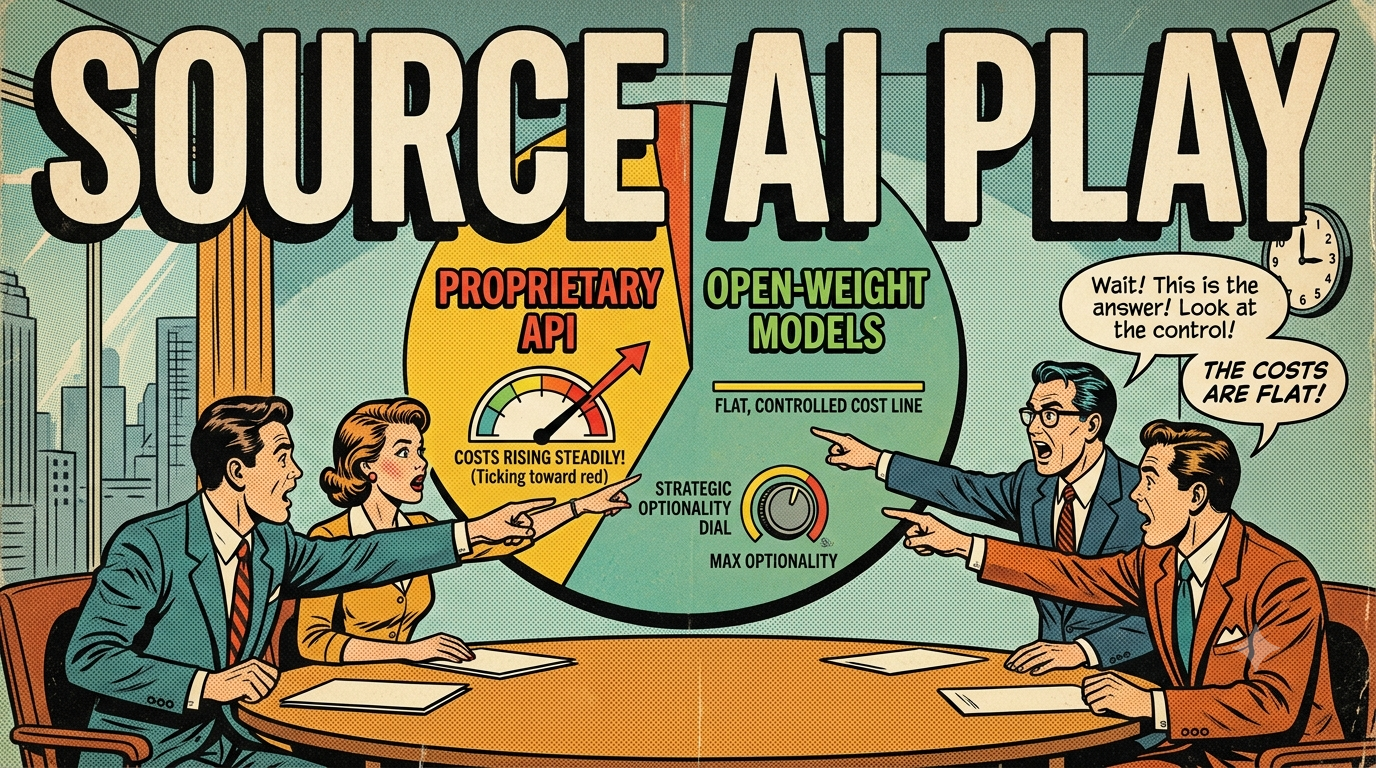
The API cost curve for frontier models has flattened and then tilted upward. Not dramatically, but consistently enough to matter at scale. The pricing per million tokens has not moved in the right direction. What has moved is the volume of tokens, and that curve is exponential.
Open-source weights break this relationship. Once you own the inference path, the marginal cost of each additional request approaches the raw compute expense. That gap between what you pay an API vendor and what raw compute costs is no longer a rounding error. At fifty million tokens per month, it is a full-time engineering salary line item. At five hundred million tokens, it is a six-figure cost category that board members can understand.
There is no ideological argument here. This is not about open-source versus proprietary software philosophy either.
What Happens When You Lose Vendor Lock-In as an Advantage
Most teams joined AI projects assuming their access to a frontier API was a competitive advantage. The model was better than what competitors could build. The results were demonstrably superior. Those assumptions held through 2024 when most API models had meaningful quality differentials.
By mid-2025, that differential collapsed for a category of workloads. Not all workloads. Classification, summarization, extraction, code generation. These use cases do not need the absolute strongest model. They need a model that is good enough and cheap enough to run continuously.
The firms that realized this first restructured their inference strategy around open-source models routed through production pipelines. They did not abandon frontier APIs. They stopped using them for everything. The frontier models went upstream, to workloads where quality mattered more than cost. The open-source weight models ran the high-throughput, low-risk workloads. Every team member had seen this pattern before in different industries. You do not use a charter flight to do grocery shopping.
This routing strategy requires infrastructure investment. You need serving infrastructure that can handle multiple model families, versioning that survives model updates, and observability that attributes cost and quality to the correct model path. Teams that treat open-source model deployment as a straightforward API replacement consistently underestimate the operational complexity. It is not a drop-in swap. It is a parallel infrastructure system.
The Real Moat Is Not the Weights
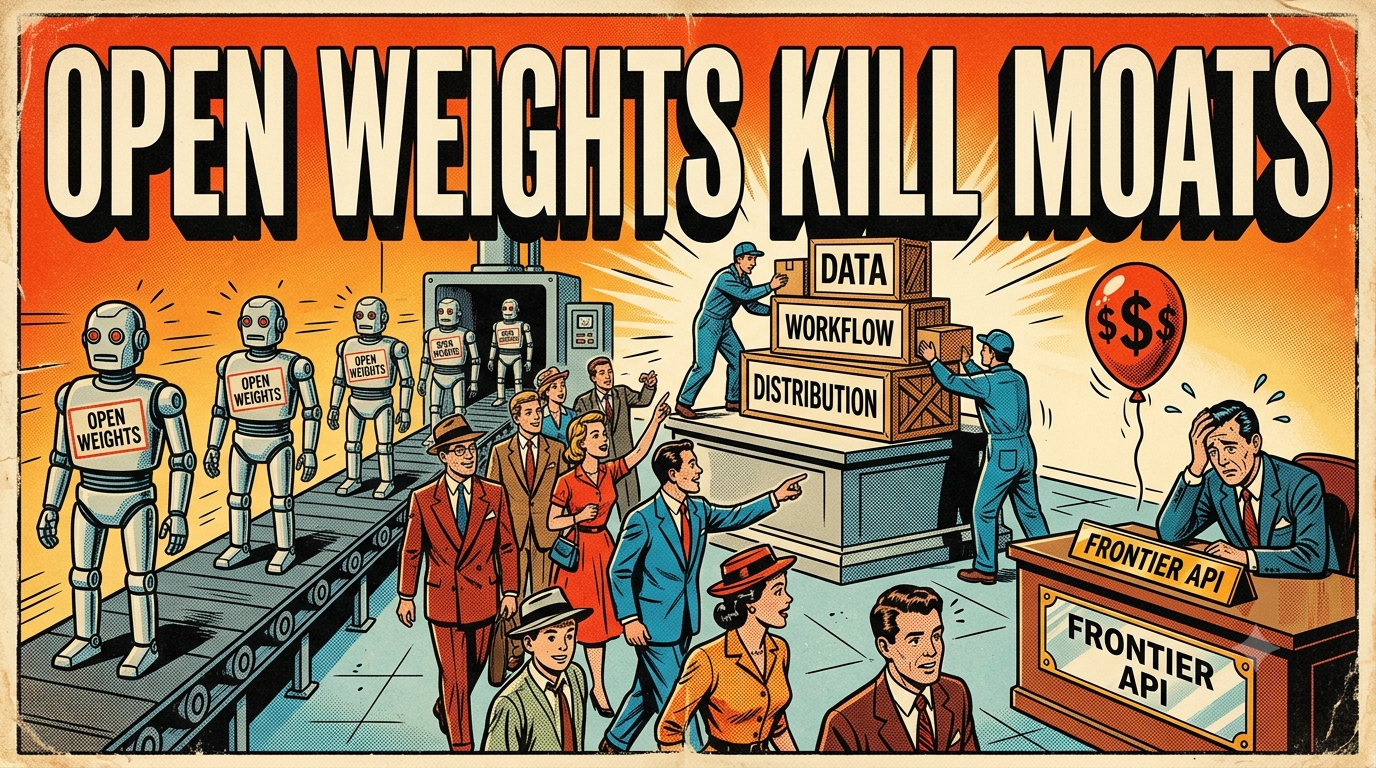
A lot of writing about open-source AI focuses on model weights as the defensible asset. Downloading Meta or Google weights and running them locally sounds like a moat strategy. It is not. Any competitor can download those same weights. The moat sits somewhere else entirely.
The moat lives in the inference pipeline. The caching layers that reduce redundant computation. The quantization strategies that preserve quality while cutting memory bandwidth requirements. The load balancing logic that routes workloads to the right model based on cost and latency constraints. These are the things that separate teams running open-source models profitably from teams that downloaded weights and then struggled to justify the engineering overhead.
This is where operational discipline matters. Teams that build their open-source inference path with the same rigor they apply to any critical production system see the cost curve bend in their favor. Teams that view model deployment as a backend engineering convenience watch their margins compress. The weights are the same in both cases. The pipeline is not.
KPMG’s Q2 2026 AI Pulse report flagged open-source arbitrage as a competitive differentiator among organizations transitioning from experimentation to active deployment. That language is deliberate. The firms leading in adoption are not treating open-source models as a cost-cutting exercise. They are building operational capabilities around them that competitors cannot replicate by simply downloading the same weights.
The Mixed Strategy That Actually Works
The best performing teams I have worked with all converged on roughly the same architecture, though none of them planned it that way initially. They split their inference workload along a simple axis: quality versus cost tolerance.
Workflows where a wrong answer creates real business risk, financial loss, or regulatory exposure, stay on the strongest models available. Those answers get routed to frontier APIs regardless of cost. The margin impact on these workloads is small because the volume is controlled and the business case is built on quality, not throughput.
Workflows that are reversible, can be batched, or where errors are recoverable move to open-weight models. Customer support draft generation, internal document summarization, code suggestion in developer tools, sentiment classification on internal communications. These are the volumes that drive API costs through the roof, and they are also the workloads where open-source models deliver acceptable quality.
The routing layer that makes this work is surprisingly simple. It does not require a new platform or expensive orchestration software. Most teams can build it with a few conditionals and a cost tracking middleware that attributes every request to the correct model path. The economics show up in the metrics dashboard, not in architectural diagrams.
The teams that get this wrong are the ones that make a binary choice. All API or all open-source. Both approaches leave money on the table. The API-only team pays vendor premiums on workloads that would run profitably on open weights. The open-source-only team risks quality failures on workloads that genuinely need frontier models. Neither strategy is wrong in isolation. Neither is correct at production scale.

What Boards Need to See to Shift Budget
I wrote last month about the P&L mandate and the need for CAIOs to show actual financial margins instead of hours saved or efficiency gains measured in vague productivity metrics. The open-source inference argument maps to that framework directly.
When a VP tells their board that switching to open-source models will reduce inference costs by sixty percent, the board asks for the supporting numbers. That is a correct question. The numbers exist and many teams have already calculated them. The question is whether those teams are building the case in a language finance teams understand.
Per-inference cost, measured in dollars per million tokens, is the relevant unit metric. Compare that to the raw compute cost for the same workload running the same model on your own hardware. The spread between those two numbers on the API side is the vendor margin. That margin disappears entirely when you own the inference path. At volume, the annual delta between API spending and owned inference runs into the hundreds of thousands for mid-size organizations. That is a line item boards understand.
The counterargument is operational complexity. Running models requires infrastructure, engineering time, and monitoring. I agree with that assessment. It is not free. The question is whether the savings from reduced API costs exceed the additional infrastructure and engineering spend. In every case I have reviewed, the answer has been yes within twelve to eighteen months of deployment. The break-even timeline is the variable, and it depends entirely on inference volume.
The Timing Window
There is a timing dimension to this that creates urgency. As open-source models continue to improve, the quality gap between frontier and open-weight models narrows for more use cases. Each model release from open-source teams effectively migrates another workload category from the API-only bucket to the open-weight bucket. That means your API spend curve goes down not because you are doing less, but because more of what you do can run on cheaper models.
Teams that have not started this transition yet are watching their open-source peers get ahead on this curve. The firms building open-source inference capabilities now have a cost advantage that compounds with each additional workload migrated. New entrants face an uphill climb trying to match those economics without the accumulated operational experience.
This is not a race. The infrastructure is not going away. It is an engineering investment with a known payback curve. The question for leadership teams is whether they want to own that curve or continue paying a premium to API vendors who already won the market for it.