· AI at Scale - Leadership - CAIO · 4 min read
My advice to board members looking to hire a Chief AI Officer
Many boards appoint Chief AI Officers but fail to provide the structural authority required for impact. Based on direct engagements with CXOs, this post outlines ten considerations for effective AI leadership. I address reporting lines, budget control, and governance maturity, shifting AI from a technical project to a strategic fiduciary matter. By aligning expectations, boards can empower CAIOs to drive measurable value while navigating a complex regulatory landscape and securing a long-term competitive advantage.

The CAIO Mandate: How Boards Can Move from Misaligned Expectations to Strategic Success
In my recent engagements with designated Chief AI Officers (CAIOs) and other CXOs, I’ve noticed a recurring - and concerning—pattern. Many of these leaders have been handed the AI mandate by their boards as an “additional” responsibility, often without the structural support or authority needed to succeed.
When a mandate is issued due to board pressure but lacks alignment on expectations, the leader’s ability to be effective is severely limited. As boards evaluate AI governance and the formalization of the CAIO role, it is critical to focus on the structural considerations that drive real impact.
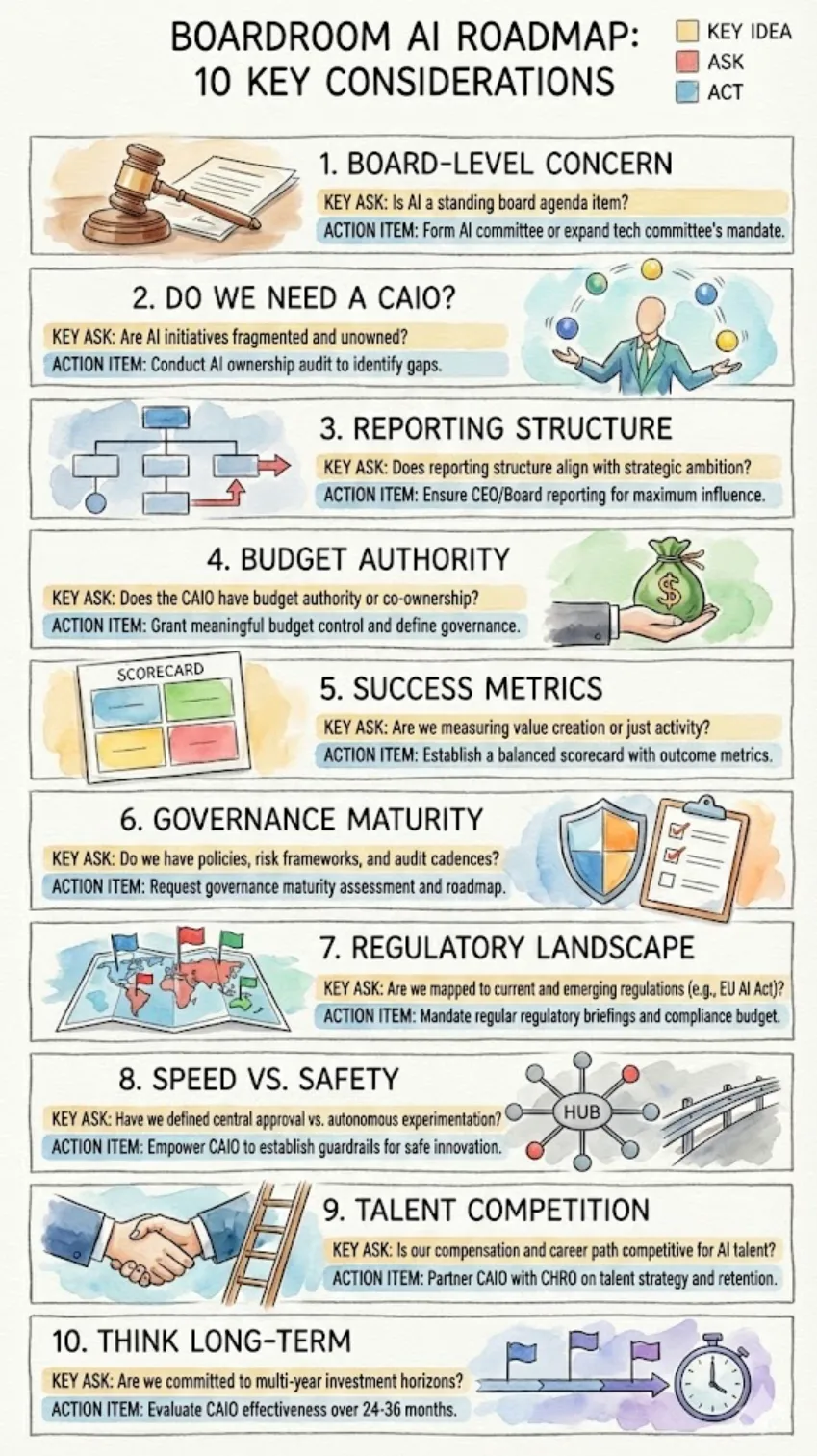
1. Recognize AI as a Board-Level Concern
AI is no longer just a technology initiative; it is a strategic, operational, and fiduciary matter. With regulatory penalties reaching 7% of global revenue and less than 2% of CEOs able to identify AI usage in their organizations, board oversight is essential.
Action: Add AI governance to the board agenda. Consider forming an AI committee or expanding the technology committee’s mandate.
2. Evaluate Whether You Need a CAIO
Not every organization requires a dedicated CAIO, but every organization needs clarity on who owns AI strategy and governance. Consider a formal CAIO role when:
- Multiple AI initiatives are underway across business units.
- AI is becoming embedded in customer-facing products or critical decisions.
- Regulatory exposure is significant (financial services, healthcare, EU operations).
- Competitive pressure requires accelerated AI adoption.
- Current leadership lacks bandwidth or expertise to manage AI holistically.
Action: Conduct an AI ownership audit. Map current initiatives and identify governance gaps.
3. Define the Reporting Structure Deliberately
More than 50% of CAIOs report to the CEO or board. This signals strategic importance and ensures independence from both technology and business unit politics.
- Reports to CEO: Maximum strategic influence, but CEO bandwidth may limit attention.
- Reports to Board: Appropriate for highly regulated industries or existential AI strategies.
- Reports to COO: Operational focus, integration with business execution.
- Reports to CTO: Technology integration focus, but may limit business influence.
Action: Align reporting structure with your AI ambition. Strategic transformation warrants CEO/Board reporting.
4. Ensure Budget Authority
CAIOs without budget authority become advisory functions with limited impact. IBM research shows 61% of CAIOs control their AI budget.
Action: Grant the CAIO meaningful budget authority or co-ownership with business units. Define investment governance mechanisms.
5. Set Clear Success Metrics
Avoid the trap of measuring AI success by activity (number of projects, models deployed) rather than outcomes (value created, risk mitigated).
Action: Establish a balanced scorecard spanning financial, operational, strategic, and organizational metrics. Review quarterly.
6. Demand Governance Maturity
Only 34% of organizations investing in AI incorporate governance. This gap exposes the organization to regulatory, reputational, and operational risk. Minimum expectations include:
- AI policy covering acceptable use, data handling, and ethical guidelines.
- Risk classification framework for AI systems.
- Audit cadence for high-risk AI applications.
- Incident response procedures for AI failures.
- Bias testing and mitigation processes.
Action: Request a governance maturity assessment. Set a roadmap for improvement with milestones.
7. Understand the Regulatory Landscape
The EU AI Act applies to any organization serving EU customers, regardless of headquarters location. U.S. regulation is fragmented but accelerating.
Action: Ensure the CAIO provides regular regulatory briefings. Map AI systems to regulatory requirements. Budget for compliance investments.
8. Balance Speed with Safety
Organizations with centralized or “hub-and-spoke” AI operating models achieve 36% higher ROI than decentralized approaches. However, over-centralization can stifle innovation.
Action: Empower the CAIO to establish guardrails that enable safe experimentation. Define what requires central approval vs. what business units can pursue autonomously.
9. Plan for Talent Competition
AI talent is scarce and expensive. Organizations without clear AI leadership struggle to attract and retain specialists.
Action: Ensure competitive compensation and clear career paths. Partner the CAIO with the CHRO on talent strategy.
10. Think Long-Term
AI is not a one-time transformation—it’s an ongoing capability that will evolve continuously. The CAIO role should be designed for sustained impact, not a short-term fix.
Action: Commit to multi-year investment horizons. Evaluate CAIO effectiveness over 24-36 months, not 12.
Conclusion
The Chief AI Officer role has evolved from an emerging concept to an operational necessity. With regulatory mandates, competitive pressure, and the governance gap all intensifying, organizations that lack clear AI leadership face material risk.
The CAIO is not merely a technical role - it’s a strategic function that bridges technology and business, coordinates across silos, ensures ethical deployment, and drives measurable value creation. For boards, the question is no longer whether to engage with AI governance, but how to structure that engagement effectively.
This article synthesizes practical experience with research from IBM, Gartner, the World Economic Forum, academic studies, and regulatory sources including the EU AI Act and U.S. Executive Order 14110.