· Rajat Pandit · AI Engineering · 9 min read
The Agent Testing Revolution: Why QA Is The Next Infrastructure Layer
Agent testing infrastructure separates prototype agents from production systems. The Strix framework signals a structural shift.

Unit testing has worked for thirty years, and it is about to fail you. Not because the technique is broken, but because the thing you are testing has changed. Agents are not functions. They are reasoning systems that make decisions, call tools, process intermediate results, and produce output based on a chain of probabilistic choices. You cannot write an assertion that says assert agent_call(user_query) == expected_answer and have it pass consistently. The answer might change tomorrow because the model sampled a different path through its reasoning chain, even with the same input and the same prompt.
I have watched teams build agent deployments where the agents work perfectly in development, pass every manual test, look great in demos, and then fail in production when they encounter input they were not trained on. The failure modes are not dramatic. The agents do not crash. They make confident but wrong decisions, call the wrong tools, or generate output that looks plausible but fails the actual task. The testing infrastructure that caught these problems in a controlled environment does not exist because nobody built it.
This is what the industry is realizing about agent testing. The trending frameworks and tools around agent evaluation and testing are not feature requests. They are structural requirements for production systems.
- Agents are probabilistic reasoning systems, not deterministic functions — standard assertions like `assert output == expected` consistently fail because the output distribution changes between runs.
- Trajectory-based testing evaluates the complete execution path — the sequence of reasoning steps, tool calls, and observations — rather than just the final output.
- Test-driven agent development means defining expected execution trajectories before writing agent code, constraining the agent by test requirements rather than testing a built agent.
- Continuous evaluation pipelines running alongside production execution catch agent drift before it affects users, making failures measurable, categorizable, and actionable.
Why Standard Testing Fails Agents
Unit testing evolved around deterministic systems. A function takes input, transforms it through a fixed algorithm, and produces a predictable output. You can test this by asserting that the output matches expectations. Integration testing does the same thing across service boundaries, asserting that service A returns the correct response to service B. End-to-end testing chains them together and verifies the complete flow produces the expected result.
None of this works for agents. The transformation is not fixed. It is driven by a model that generates responses based on probability distributions. The same input can produce different outputs across runs. The function path changes between executions. There is no single algorithm to test, only a distribution of possible behaviors.
This is not a problem that prompt engineering solves. Better prompts reduce variance, but they do not eliminate it. The fundamental nature of a probabilistic reasoning system means you are testing a range of possible behaviors, not a single deterministic path. Standard testing infrastructure cannot express that.
The teams that figured this out first built different testing primitives. Instead of asserting exact outputs, they assert properties of the output. Did the agent call the correct tool? Did it provide a response in the expected format? Did the tool output match the criteria that indicate successful execution? These are property-based tests that can tolerate some output variation while still verifying the essential correctness of agent behavior.
The Trajectory-Based Testing Model
The breakthrough approach that most production-grade agent testing frameworks converge on is trajectory analysis. Instead of testing individual function calls, you test the complete execution path. An agent does not execute a single step. It reasons, selects a tool, processes the result, reasons again, and repeats until it produces a final answer. That complete chain of decisions is the agent’s trajectory, and that is what you need to test.
Trajectory testing requires instrumentation that every agent execution step. What was the input? What was the reasoning? What tool was called and with what parameters? What was the output? What was the next step? You replay or evaluate these trajectories against expected patterns to assess whether the agent behaved correctly.
The evaluation can be deterministic or model-based. A deterministic evaluation checks if the agent called the expected tool. A model-based evaluation uses a judge model to assess whether the agent’s final answer is correct, which introduces another layer of probabilistic evaluation on top of the agent’s own probabilistic output. The judge model evaluation has its own failure modes. You need to understand the judge’s accuracy and be honest about where it adds noise instead of clarity. See Automated Agent Trajectory Evaluation for a deep dive into evaluation strategies.
The most robust approach I have seen uses a hybrid evaluation strategy. Deterministic checks for tool selection and parameter correctness, format validation for response structure, and a separate model evaluation for answer quality. This layered approach catches different classes of errors. Deterministic checks catch structural failures where the agent goes completely off track. Format validation catches issues that are visible but do not indicate fundamental agent failure. Model evaluation catches quality issues that require nuanced judgment.
Test-Driven Agent Development
The concept is not new. Test-driven development means writing tests before writing production code. You define what the code should do, you write a test that verifies that behavior, and you write code that makes the test pass. This forces clarity about what the system needs to do before you build it.
Applying TDD to agents is where the paradigm shift actually happens. You need to define the expected execution trajectories before the agent runs them. What tools should the agent call for a given task? In what order? What are the expected parameter constraints? What constitutes a successful outcome versus a failure? You write those expectations as test cases before you write any agent code.
The agent code itself becomes a reasoning system constrained by test expectations. You are not writing an agent that you test after it is built. You are writing an agent that is designed around test requirements that have already been defined. This changes how you think about agent architecture. Instead of designing the agent and then asking what to test, you start with what the agent needs to do correctly and build the agent around those requirements.
TDD for agents is harder than TDD for deterministic systems because the test expectations involve behavioral ranges rather than exact values. A test for a payment processing function asserts that the correct amount is charged to the correct account. A test for an agent that processes refund requests asserts that the agent calls the refund tool with the correct order ID and calculates the refund amount based on the correct policy. The parameters are deterministic. The reasoning path that leads to those parameters is not. The test needs to verify both.
The Infrastructure That Makes Agents Reliable
Testing agents in isolation is one problem. Monitoring them in production is another. The infrastructure that tracks agent behavior, logs execution trajectories, evaluates correctness, and flags failures needs different capabilities than traditional application monitoring.
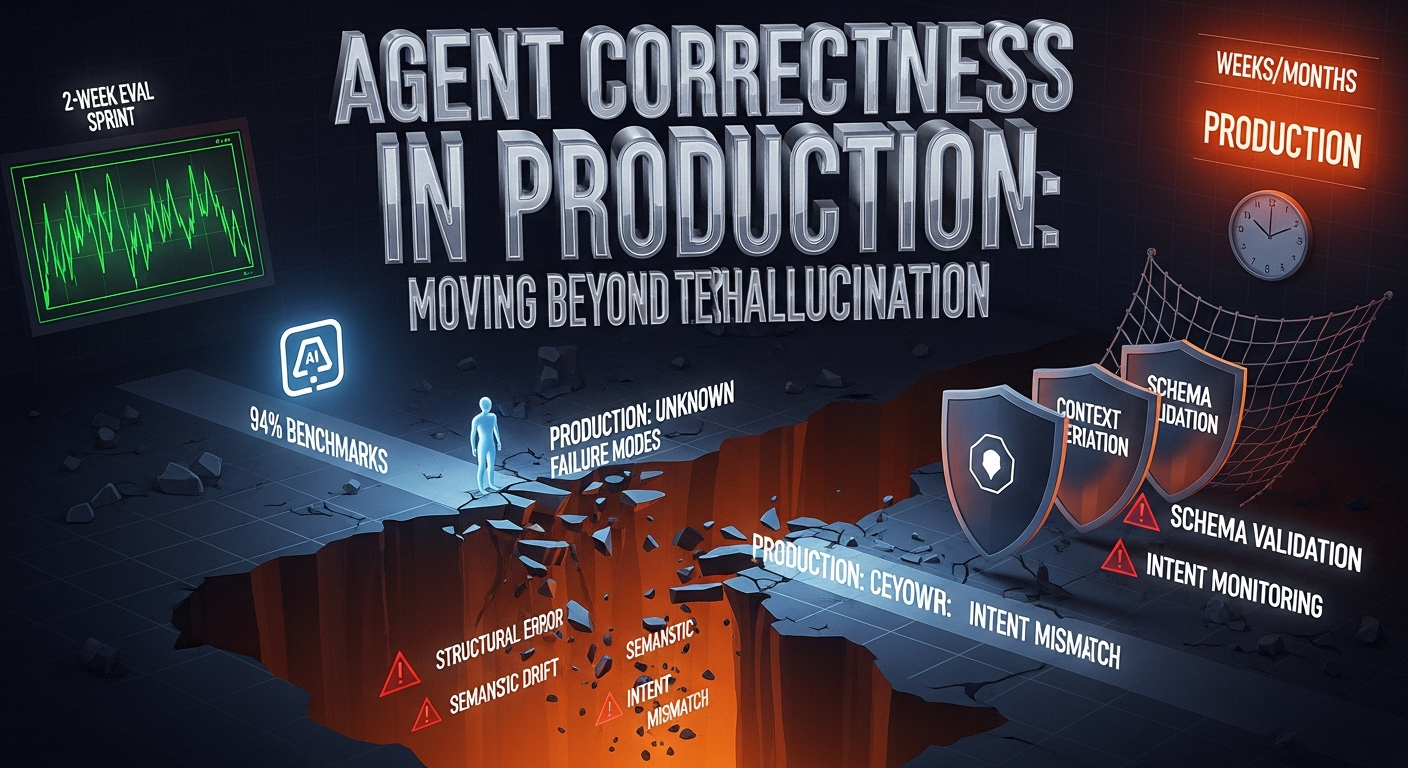
Traditional APM tools track request latency, error rates, and resource utilization. Agent monitoring needs to track execution paths, tool call sequences, reasoning patterns, and correctness metrics. When an agent fails, you need to know not just that it failed, but how it failed, which step in its reasoning chain broke, and what the correct path would have been. This mirrors the approach in Agent Correctness in Production: Moving Beyond Text Hallucination, which covers production monitoring for reasoning-dependent systems.
This is the infrastructure layer that most agent deployments skip, and it is the layer that determines whether agents remain reliable over time. An agent that passes all tests today may drift into incorrect behavior tomorrow as its underlying model updates or as the environment it operates in changes. Continuous monitoring and evaluation catches that drift before it affects users.
The teams that get this right build evaluation pipelines that run alongside production execution. Every agent response gets evaluated against expected outcomes. The evaluation results feed back into the system, triggering alerts when correctness metrics drop below thresholds or when specific patterns of failure start appearing. This is not a one-time evaluation at deployment time. It is continuous.
The Testing Gap That Kills Agent Deployments
I have seen dozens of agent deployments fail, and the pattern is always the same. The agent was built, tested in development, and deployed to production. Everything looked good for the first few weeks. Then it started failing on inputs it had never seen before. The failures were not catastrophic. The agent was still producing output, still calling tools, still completing most tasks. But the quality had dropped. The agent was making more errors. The team could see it but could not quantify it.
Without a testing infrastructure, you cannot measure agent quality over time. You can see that errors increased, but you do not know by how much, in what categories, or which parts of the agent code caused them. You cannot make targeted fixes because you cannot identify the root cause. You end up either rewriting the agent completely or accepting degraded performance.
The testing infrastructure does not prevent agents from failing. No testing infrastructure prevents bugs in production. It does something more important. It makes failures measurable, categorizable, and actionable. When an agent produces an incorrect answer, the testing pipeline tells you which tool was called incorrectly, what the expected parameter was, and what the actual parameter was. You fix the tool selection logic. You retest with the same trajectory. The fix is verified against the test cases before it goes back into production.
This is not a luxury for agent teams that have the engineering capacity for advanced testing. This is a requirement for any team deploying agents that perform actual work, process real data, or make decisions that affect business outcomes. The agents that survive production are the ones that have testing infrastructure around them. The ones that fail do not, and their teams never knew exactly why until it was too late.