· AI Infrastructure · 7 min read
The Inference Cost Wall: When Fine-Tuning Beats Frontier API Calls
The inference cost wall in AI: analyzing the inflection point where running distilled models on neocloud infrastructure beats paying per-token for frontier models.
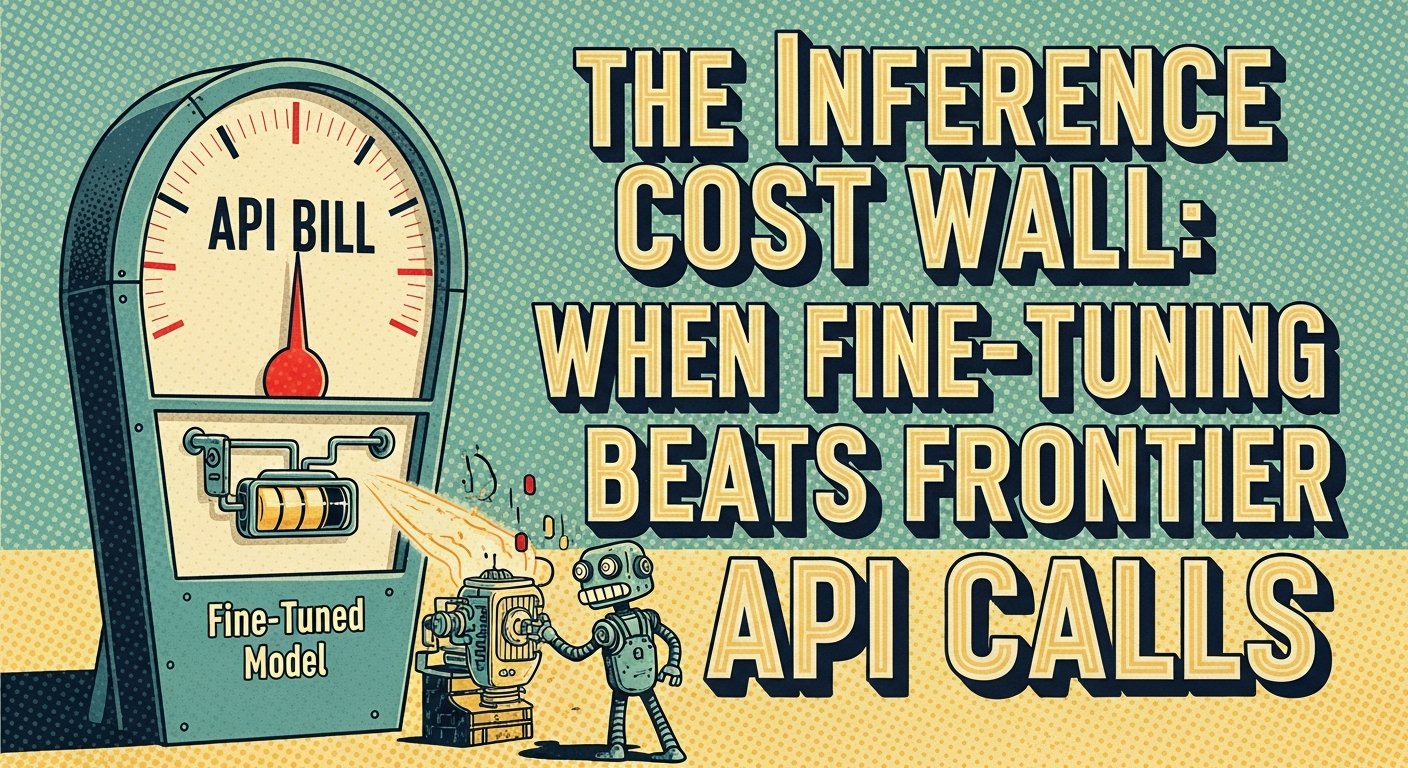
- Per-token pricing for frontier models has been the default assumption for building AI products. That assumption is collapsing.
- Fine-tuned distilled models running on neocloud GPUs now deliver nearly identical output quality to frontier models at 1 to 10 of the cost.
- The inflection point varies by use case: simple classification flipped in 2024, reasoning tasks are flipping in 2026.
- The companies that survive will be those that build intelligent model routing systems, not those that lock themselves into single providers.
I have a simple question that I ask every engineering team that approaches me about their AI architecture.
How much do you spend on model API calls per month?
And then I ask the follow-up. Do you know what percentage of those calls actually need a frontier model?
The answer almost always makes the team uncomfortable.
Most teams send everything to the most expensive model they can afford. A billing question goes to a $0.50-per-call GPT-class model. A code review question goes to the same model. A creative writing task goes to the same model. The reason is simple. It is easier. It is cheaper in engineering time to write one API call that works for everything than to build a system that intelligently routes between model tiers.
But that ease comes at a cost. And as inference costs climb with growth, organizations are hitting what I call the inference cost wall.
The Math That Breaks Growth
Let me walk through a concrete example.
Your company builds an AI-powered customer support tool. You charge your enterprise clients $500 per month per agent seat. Each agent has an average of 100 customer interactions per month. That is 10,000 total API calls per seat per month.
At current frontier model pricing of roughly 2.50. You are spending 500 per seat revenue.
That is not a business. It is a donation to the model provider.
Even if you negotiate an enterprise discount that brings your pricing down to 12,500 per seat per month against $500 in revenue. The gap is unbridgeable at this trajectory.
But here is where the math changes.
A well-distilled 7B model running on a GPU can handle many of those customer support interactions with 90 to 95 percent of the quality of the frontier model. And that GPU costs roughly 1.50 per hour. Your 10,000 interactions might consume about 50 hours of GPU time. That is 75 per month for every enterprise agent seat.
The difference is extraordinary. You go from spending 75 on neocloud GPU time. That is a 330x cost reduction.
Even accounting for the fact that the distilled model is not quite as good as the frontier model, the economics are undeniable. The question is not whether you should move. The question is how you manage the transition.
The Quality-Cost Tradeoff Curve
Here is the thing that most teams do not think about. Not every question deserves the same quality level.
Some customer interactions are genuinely complex. They involve multi-step reasoning, cross-referencing multiple knowledge bases, and navigating ambiguity. Those interactions benefit from a frontier model’s broader training and superior reasoning capability.
Most interactions are not like that. They are questions about your product features, billing, account status, or standard troubleshooting. These interactions follow relatively predictable patterns. They benefit from a distilled model that was fine-tuned specifically on your support data.
I have seen organizations build routing systems that estimate the complexity of each incoming request. Simple routing rules handle the straightforward questions. A small classifier model predicts the complexity score. If the score crosses a threshold, the request gets routed to a frontier model. If it does not, it goes to the distilled model.
The result is not just cost savings. It is also faster response times. Distilled models are smaller. They generate tokens faster. End-to-end latency drops from an average of 3 to 4 seconds to under a second for the routed-through category, which typically represents 70 to 80 percent of total traffic.
That latency improvement has a real impact on user experience and satisfaction scores. So the routing system is actually improving both cost and quality simultaneously.
The Inflection Point Is Moving
The inflection point where fine-tuning beats calling an API is not static. It is moving.
In 2023, the gap between distilled and frontier models was so large that the cost savings were not worth the quality loss for anything beyond trivial tasks. You saved money but your product quality degraded noticeably.
In 2024, the gap narrowed significantly. Distilled models became genuinely useful for classification, summarization, and straightforward generation tasks. The inflection point moved from trivial tasks to routine tasks.
In 2026, we are watching the inflection point move into genuinely complex reasoning territory. Some of the newer models, particularly those trained with advanced techniques like direct preference optimization, are now matching frontier model output on domain-specific tasks. The gap is no longer “frontier wins everything except basic queries.” It is a much more nuanced landscape.
This makes the routing problem harder. Because when the distilled model gets 85 percent of tasks right but misses the 15 percent that matters, the cost savings from routing those 85 percent need to be sufficient to justify the risk of the 15 percent going wrong.
The companies that are winning at this are building continuous evaluation pipelines. They are running every distilled model output through a quality checker that can detect when the output quality has degraded below threshold and escalate that specific request to a frontier model before the user notices anything is wrong.
This means the distilled model handles the majority of requests efficiently, the frontier model handles edge cases, and the automated quality checker catches failures before they reach the end user. The effective quality approaches 100 percent. The effective cost approaches the neocloud distilled model pricing.
You get frontier-level quality at distilled-model pricing. That is the inference arbitrage opportunity at its most powerful.
Building the Routing Layer
The architectural pattern that is emerging looks like this.
At the bottom, you have your model tiers. Tier 1 is your distilled models fine-tuned on your specific domain data, running on GPU infrastructure. Tier 2 is your frontier model API access, kept as a fallback for complex cases.
In the middle, you have the routing layer. This is a small classifier model, perhaps a 1B to 3B parameter model running on the same neocloud infrastructure, that analyzes each incoming request and predicts whether it will be handled well by your tier 1 models or whether it needs escalation to tier 2.
The routing classifier itself costs roughly $0.0001 per request to run. Its job is simple. Route the right request to the right model tier. It does not need to be perfect. It just needs to be good enough that your average inference cost per request drops dramatically while maintaining acceptable quality levels.
Above the routing layer is an evaluation framework that continuously measures the output quality of your tier 1 models on different request categories. The evaluation results feed back into the routing classifier to improve its accuracy over time.
This creates a flywheel. The more requests you process, the more evaluation data you generate. The better your evaluation data, the smarter your router becomes. The smarter your router becomes, the lower your average inference cost rises while maintaining or improving output quality.
The teams that build this architecture early are building a moat that is not around model quality or distribution. It is around inference efficiency. And in a market where the raw intelligence layer is becoming commodity, efficiency is the scarcest and most valuable resource.