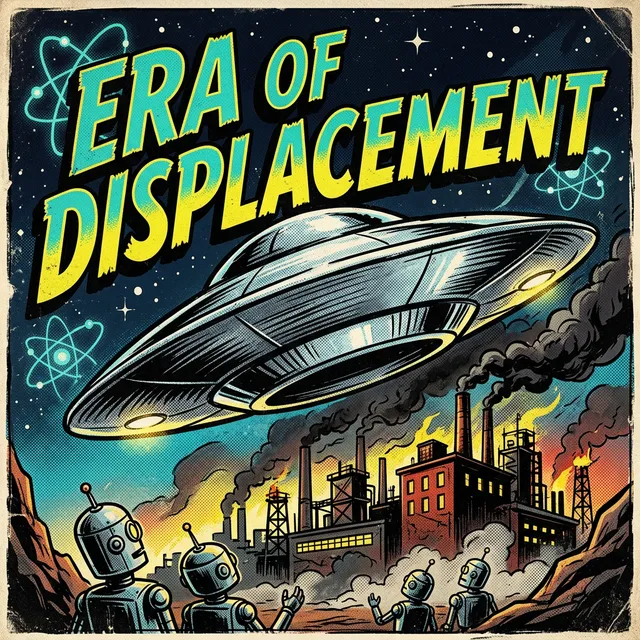
 The Era of Displacement: A shift from legacy to lean.
The era of easy cloud sales is over. For fifteen years, we lived in the “Greenfield Era.” If you were selling software or infrastructure, your primary competitor was nothing. You were competing against pen and paper, against on-premise servers that crashed when it rained, or against a spreadsheet that one guy named Sathyan managed on a USB drive.
Selling in a greenfield is evangelism. You are a missionary bringing fire to people freezing in the dark. You don’t need to explain why your fire is better than their fire; you just need to show them that being warm is possible.
But today, the map is full. The Fortune 500 isn’t looking for a cloud provider; they have three. The mid-market isn’t looking for a CRM; they are drowning in one.
We have entered the Era of Displacement.
Your competitor is no longer “nothing.” It is “good enough.” It is a ten-year-old contract, a team of twenty engineers certified in a specific legacy syntax, and a CIO who built their career on the decision to buy the very thing you are helping them evolve.
This is not evangelism. This is surgery.
The Theory of Roots
Why does bad software survive?
In biology, an organism survives by adapting to its environment. In enterprise technology, an incumbent survives by becoming the environment.
Consider “The Sunday Night Server.” A bank we worked with had a mainframe module that processed transactions every Sunday at 2 AM. It was slow, expensive, and written in a language that hasn’t been taught in universities since 1998. The bank hated it. Every year, the CTO promised to replace it.
But they didn’t. Why? Because the module touched the billing system, which touched the compliance audit log, which touched the CEO’s Monday morning dashboard. To pull out that one “bad” module would require rewriting the connections to twenty “good” ones.
The incumbent wasn’t strong because it was good. It was strong because it was connected.
Consider the “Ghost Vendor” incident. A team we knew spent six months trying to displace an entrenched database incumbent. They had the better tech, the faster UI, and the lower price. But they couldn’t get past the CIO.
The twist? The Incumbent’s CEO was the CIO’s brother-in-law. It was a “blood-lock.”
Most teams would have walked away. But this team didn’t fight the relationship; they fought the roots. They identified a specific data-privacy compliance gap that the brother-in-law’s legacy platform legally couldn’t fulfill without a massive architectural overhaul. Sathyan, the infrastructure lead who had seen three migrations fail, was the one who quietly pointed out the loophole during a late-night tea break. They pitched the “Compliance Air Gap” as a mandatory regulatory requirement. The CIO had no choice—he had to let the challenger in or risk a public audit. He still liked his brother-in-law, but he liked his job more.
AE Field Guide: The Root Discovery Checklist
As an Account Manager, you don’t need to know the code, but you must know where the roots are buried. During your first discovery filter coffee, skip the feature pitch and listen for these “Root Signals”:
- The “Tribal Knowledge” Dependency: “What happens if Sathyan (the lead systems admin) goes on vacation for three weeks?” If the answer is “We don’t touch the server,” you’ve found a root.
- The “Vendor Lock-in” Tax: “How much of your team’s weekly cycle is spent on ‘janitorial work’ for [Incumbent]?”
- The “Sunday Night” Syndrome: “Is there a specific system your team is genuinely afraid to reboot or upgrade?”
- The Training Debt: “When was the last time your team was certified on a new architecture, or are they still maintaining scripts written in 2012?”
Every “Yes” to these questions is a crack in the incumbent’s fortress.
This is the Theory of Roots. In a displacement sale, you are not fighting the feature set of the competitor. You are fighting the roots they have grown into the customer’s organization. These roots are not just technical (API dependencies); they are financial (committed spend), operational (custom workflows), and emotional (status quo bias).
Most sales teams fail because they bring a weedwhacker to a job that requires a shovel. They hack at the leaves-”Our UI is 10% faster!”-while the roots remain untouched.
The Specialization Thesis
If the incumbents are so deeply rooted, how do we win?
We win because the “Generalist Consensus” is breaking.
For a decade, the safe bet was to buy everything from one vendor. You bought your compute, your database, your security, and your analytics from the same Hyperscaler or Platform Giant. It was the “One Throat to Choke” model. It wasn’t perfect, but it was integrated.
But AI changed the math.
AI is not a feature; it is a resource hog. It requires specific, high-performance compute (GPUs) and specialized data architectures that generalist platforms struggle to provide cost-effectively.
The Incumbents are like department stores. They sell everything, but they don’t sell the best of anything. They are “miles wide and inches deep.”
New challengers are emerging who are “inches wide and miles deep.” They don’t try to be your operating system and your email provider and your database. They just do one thing-vector search, or GPU inference, or identity security-orders of magnitude better than the department store.
This is the Specialization Thesis: The only way to displace a generalist incumbent is with a specialist wedge.
The Mental Shift
To succeed in this era, you must change your definition of a “win.”
In the Greenfield Era, a win was a signed contract for the whole platform. In the Displacement Era, a win is a Beachhead.
You will not rip out the entire ERP in year one. You will not migrate 5,000 applications to your cloud in Q1. If you try, you will trigger the “Immune Response” of the incumbent, who will drop their prices by 40% to stop you.
Instead, you find the one room in the house that is on fire. You find the specific workload where the Incumbent is failing so badly that the pain outweighs the pain of switching. You solve that. You plant your flag.
And then, you let your roots grow.