 The noise of the many conceals the power of the few.
Deepak, the company’s newly appointed “Lead for GenAI Acceleration,” was a whirlwind of energy and unvetted LinkedIn summaries. He had cornered Venkat in the breakroom, blocking his path to the filter coffee machine.
“Venkat, sir! I have the shortlist,” Deepak announced, thrusting a tablet into Venkat’s face. It was a spreadsheet with fifty rows, color-coded in neon shades of “Pilot Ready” and “Disruptive Potential.” “We need to trial at least ten of these by Friday. One is an IDE plugin that uses agents to write your unit tests while you sleep. Another is a CLI tool that translates your Jira tickets directly into GoLang. It’s a bazaar out there, sir! Total Cambrian Explosion!”
Venkat blinked, unimpressed. “Deepak, a Cambrian Explosion also resulted in a lot of trilobites. They are all fossils now. Do any of these tools know that our database schema hasn’t been updated since 2012, or will they just suggest ‘modern’ code that breaks our legacy production?”
Deepak froze, his neon spreadsheet suddenly looking a bit less disruptive.
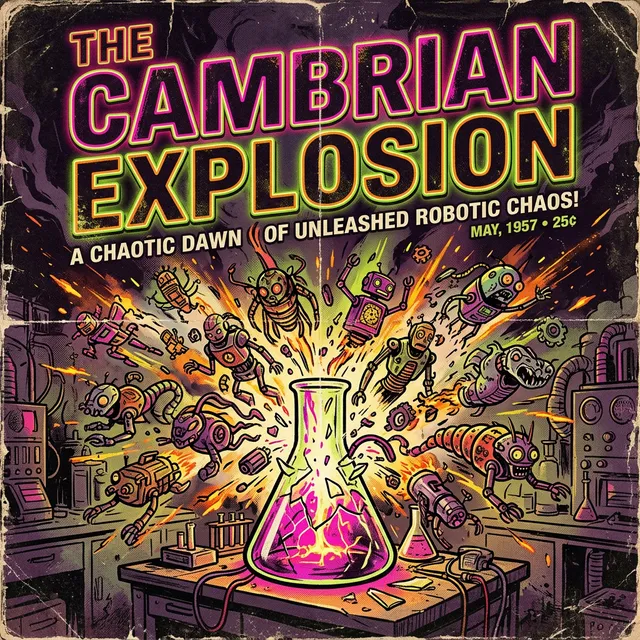
In biology, the Cambrian Explosion was a period where life diversified at a frantic, experimental pace. Nature tried everything. Most of it died. In 2024, software engineering entered its own Cambrian phase. If you look at the landscape today, you see a terrifying sprawling bazaar. There are 5,000 “AI Coding Tools.” There are IDE extensions, CLI wrappers, chat bots, agentic swarms, and browser plugins. Every startup with a wrapper around an LLM claims to be the “GitHub Copilot replacement.”
For a decision-maker, this is paralysis.
The mistake most leaders make—and the one Deepak was currently making—is trying to evaluate the tools. They create spreadsheets comparing 50 different feature sets: “Does X have a chat window? Does Y support Python?”
This is the wrong taxonomy. You don’t need to evaluate 5,000 tools. You need to understand that there are only three distinct species of AI emerging from this primordial soup. If you understand the species, you can ignore the noise.
The Three Species
1. The Autocomplete (The “Ten-Second” Loop)
This is the oldest species. It lives in the phantom text ahead of your cursor.
- Role: The Tactician.
- Value: It removes the friction of syntax. It remembers how to write a regex so you don’t have to.
- The Office Reality: As Venkat says, “It’s like power steering. It helps you turn the wheel, but it doesn’t know you’re driving into a ditch.” Move on.
2. The Context Engine (The “Ten-Minute” Loop)
These tools don’t just guess the next word; they understand the whole codebase. They use RAG (Retrieval-Augmented Generation) to answer questions like “Where is the authentication logic for the user profile?”
- Role: The Librarian.
- Value: It reduces “Archeology”—the time Venkat spends explaining to juniors why we can’t delete the
GlobalHelperclass from 2008. - The Trap: Most tools claim to do this, but fail at scale. A tool that understands a 10-file repo is a toy. A tool that understands a 10,000-file monolith is a weapon.
3. The Agent (The “Ten-Hour” Loop)
This is the new predator. An agent doesn’t just suggest code; it does the work. You give it a task (“Upgrade the dependency and fix all breaking changes”), and it go away. It spins up a terminal, runs tests, fixes errors, and comes back with a Pull Request.
- Role: The Intern.
- Value: It decouples human attention from execution.
- The Risk: Infinite loops. An agent that gets stuck trying to fix a bug it created is a resource black hole. Deepak once left an agent running over a long weekend; it spent $400 in API credits trying to refactor a CSS file into alphabetical order.
The Paralysis of Choice
The reason you feel overwhelmed is that you are looking for a “Winner” in a market that hasn’t consolidated. You are waiting for the “iPhone moment” where one device does everything.
The winning strategy for 2026 is not to find one tool that does it all, but to build a Unified Context Plane.
The danger is not “choosing the wrong tool.” The danger is fragmenting your truth. If your Autocomplete tool (Species 1) doesn’t talk to your Agent (Species 3), you have created a schizophrenic workflow. The Agent fixes a bug, but the Autocomplete doesn’t know about it, so it suggests the old, broken code again.
The Legacy Context (Archeology at Scale)
“Venkat sir,” Deepak interrupted, his neon tablet flickering. “What about the 2012 database? Should we just rewrite it in Rust using the agent?”
Venkat gave him a look that could curdle milk. “Deepak, rewriting a thousand-table monolith you don’t understand is not ‘acceleration.’ It’s a suicide mission. The true power of these tools isn’t in writing new code we don’t need. It’s in performing Archeology on the code we already have.”
For the skeptical executive, this is the most important insight: AI is the only tool in history that can explain a 20-year-old undocumented system to you in seconds. It can map the hidden dependencies, summarize the forgotten logic of a departed architect, and tell you why that specific shell script from 2008 is still holding the billing system together.
Stop using AI just to generate new features. Use it to reclaim the context of your legacy systems.
The Consolidation Thesis
Stop looking at the 5,000 features. Look for the Data Gravity.
The tools that will survive the extinction event are not the ones with the flashiest demos. They are the ones that can ingest the most context—your Jira tickets, your Slack conversations, your Confluence docs, and your Code—and hold it in a single, coherent mental model.
In the Cambrian Explosion, the organisms that survived weren’t the weirdest ones. They were the ones with the best nervous systems. Venkat knows this. He doesn’t want ten tools. He wants one nervous system that actually understands why the servers are smoking.
Choose the nervous system, not the limb.
🛠 The Executive Checklist
If you are a VP of Engineering or a CTO, use these three questions to audit your AI strategy for this quarter:
- Fragmented Truth vs. Unified Plane: Do our developers use three different AI tools that don’t share context? (If yes, you are building technical debt at the speed of light).
- Creation vs. Archeology: What percentage of our AI usage is for generating “New Boilerplate” vs. “Explaining Legacy Systems”? (Aim for at least 30% Archeology to maximize ROI).
- Limb vs. Nervous System: Are we buying “Features” (e.g., a better chat window) or “Infrastructure” (e.g., a context engine that understands our 10,000-file monolith)?
Key Takeaways
- Decision Makers: The real ROI of AI isn’t “typing faster.” It’s reclaiming the $10M of lost context trapped in your undocumented legacy systems.
- Managers: Stop evaluating tools; start evaluating Context Depth. A tool that doesn’t understand your specific database schema is just a generic hallucination engine.
- Engineers: Your job is no longer to “memorize syntax.” It is to become a Context Provider—the person who ensures the AI knows exactly which “vibe” the architecture requires.