 Time is no longer linear. It is instantaneous.
Rajesh, the Senior Director of Delivery, was troubled. He had spent three million dollars on AI licenses, but his Jira dashboard still looked like a graveyard of “In Progress” tickets. He walked over to Venkat’s desk.
“Venkat, I’m looking at the velocity charts. Why aren’t the engineers typing more? I expected a 40% increase in lines of code by now. Are they just using the AI to write poetry?”
Venkat didn’t look up from his screen. He was watching an agentic workflow refine a database migration. “Rajesh, asking an engineer to ‘type more code’ to increase productivity is like asking a surgeon to ‘make more cuts’ to finish the surgery faster. You don’t want more code. You want more solved problems.”
Venkat turned his monitor slightly. “Look at this. In the time it took you to walk from your corner office to my desk, I have searched the legacy codebase for the bottleneck, drafted a fix, implementation-tested it in a sandbox, and verified it against our production snapshots. In the old days, that would have been four meetings, three Jira tickets, and two weeks of ‘Jira Purgatory.’ Now, I’ve done it before my filter coffee got cold.”
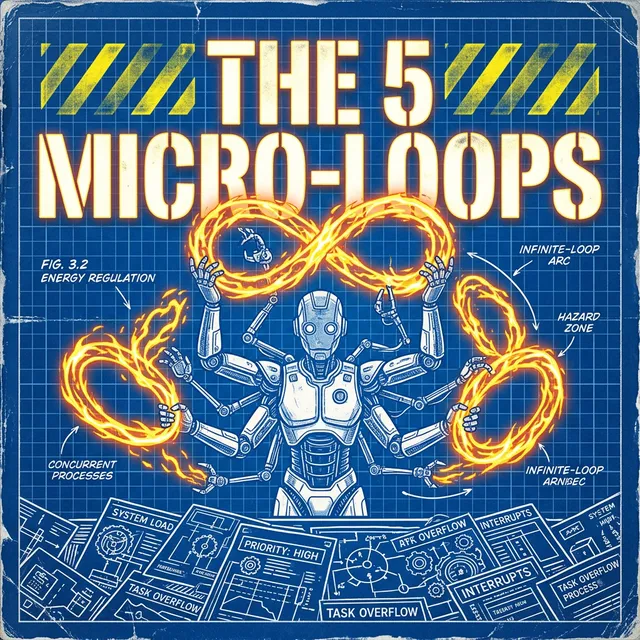
Software engineering is not one big loop. It is five specialized “Micro-Loops” stitched together. Traditionally, each loop had a huge “Cost of Context Switching.” AI doesn’t just make the loops faster; it collapses them.
1. The Discovery Loop (Search)
- Old Way: Google “How to center a div,” read 5 StackOverflow threads, decipher 2018 answers while dodging ads. (Time: 15 mins).
- New Way: “Center this div.” Context-aware answer in IDE. (Time: 5 seconds).
- The Office Reality: Venkat no longer has to listen to juniors arguing about which blog post has the “best” answer. The ground truth is in the IDE.
2. The Design Loop (Plan)
- Old Way: Whiteboarding for hours, writing a Google Doc that no one reads, and forgetting the edge cases until they blow up in production.
- New Way: “Draft a plan for this feature.” Agent proposes 3 approaches with pros/cons based on our actual architecture.
- Impact: You explore the “Solution Space” much wider before writing a single line of fragile code.
3. The Implementation Loop (Build)
- Old Way: Typing boilerplate. Hunting for missing semicolons. Struggling with obscure library syntax.
- New Way: “Scaffold the API.” “Ghost-write” the function logic.
- The Shift: Typing is no longer the bottleneck. Thinking is. As Venkat says, “The AI is the mason; the human is the architect. One lays the bricks, the other ensures the house doesn’t fall down.”
4. The Verification Loop (Test)
- Old Way: Write code. Run. Fail. Add
console.logstatements. Run. Fail. Curse. - New Way: Agent runs tests in the background. “I found a latent race condition in line 40, here is the fix.”
- Compression: The “Feedback Loop” tightens from minutes to milliseconds.
5. The Review Loop (Merge)
- Old Way: A tired senior engineer clicks “LGTM” because they have ten other PRs to review and a meeting starting in two minutes.
- New Way: AI summaries point out the performance regressions and security flaws automatically.
- The Result: Humans stop reviewing Syntax and start reviewing Semantics.
The Compression
When you compress these loops, you don’t just get “Faster Software.” You get “Flow.”
The developer never leaves the IDE. They never enter the “Meeting-Jira-Slack” death spiral. They stay in the “Problem Space” for hours. This is the “10x” origin story. It’s not about magic; it’s about the elimination of the friction that Rajesh’s Jira board used to track so diligently.
“Rajesh,” Venkat said, finally taking a sip of his coffee. “Don’t measure the velocity of the typing. Measure the collapse of the wait time. That’s where your three million dollars is really hiding.”
🛠 The Wait-Time Audit
Use this worksheet to identify where your team is actually losing time. AI doesn’t just speed up coding; it collapses the space between these five loops.
| Micro-Loop | Pre-AI Baseline (Wait Time) | Post-AI Target (Wait Time) | Primary AI Lever |
|---|---|---|---|
| 1. Discovery | 15-30 mins | < 1 min | Context-Aware IDE RAG |
| 2. Design | 2-4 hours | 10 mins | ”Plan-to-Code” Agents |
| 3. Implementation | Days | Hours | Ghost-writing & Scaffolding |
| 4. Verification | 1 hour | < 5 mins | Autonomous Unit-Test Runs |
| 5. Review | 4-8 hours | 30 mins | Synthetic Reviewer (L0) |
Key Takeaways
- Decision Makers: Stop measuring “Velocity” in story points. Start measuring “Loop Collapse.” The faster a developer moves from “Discovery” to “Review” without leaving the IDE, the higher your ROI.
- Managers: Your job is to remove the friction that forces developers into the “Meeting-Jira-Slack” death spiral. If the Review Loop takes longer than the Build Loop, your process is the bottleneck, not the engineering.
- Engineers: Use AI to collapse the Discovery and Verification loops. If you spend less time hunting for syntax and context, you can spend more time on the Design loop where senior value is forged.