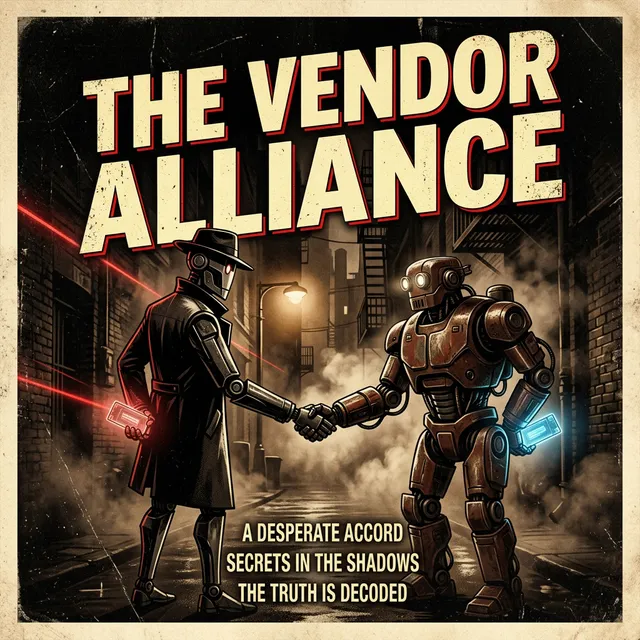
 *Trust, but verify. Partner, but protect.*
Tiffany, the “Global Head of Strategic Account Wellness” for a Silicon Valley AI startup, was smiling so hard her AirPods were in danger of falling out.
“Venkat, we are so excited about your team’s engagement metrics! You’ve generated over five million lines of code in just six months. We’ve saved you approximately eight centuries of human labor. We’d love to talk about doubling your ‘seat count’ for next year to maximize our synergistic alignment.”
Venkat leaned closer to the webcam, his face a mask of skeptical geometry. “Tiffany, I don’t care about ‘seats.’ I care about the ‘Zero-Touch’ metric. Of those five million lines, how many caused a production incident because your model truncated the context of our database drivers?”
Tiffany’s smile twitched. “Well, our dashboard doesn’t track that specifically, but our NPS scores are—”
“I don’t need NPS,” Venkat interrupted. “I need to know about the Prenup. If we decide to move our ‘context layer’ to a different vendor next quarter, how do I export the knowledge graph your tool has built about our legacy code? Or do you own our intelligence now?”
“We… we don’t really have an export button for that,” Tiffany admitted.
“Then we aren’t partners,” Venkat said, his voice as dry as a desert wind. “We are just hostages.”
The era of “buying a license and filing a support ticket” is over. When you buy an AI coding tool, you are not buying software. You are hiring a Synthetic Employee. You need to interview the vendor just as you would interview a VP of Engineering.
The “Deep Tech” Success Model
Traditional “Customer Success” is a relic of the SaaS era. It cares about log-ins and feature usage. AI Success is different. It cares about whether the model is hallucinating your private API keys or whether the context window is truncating critical business logic.
You need a vendor who has Engineers, not just account managers, on the other end of the line. You need a “Deep Tech Check-in” where you discuss architectural fit. As Venkat likes to say, “I don’t want to talk to Tiffany about ‘wellness.’ I want to talk to the engineer who fine-tuned the model about its tendency to hallucinate Python decorators.”
The Prenup: Architecting for Independence
The nightmare scenario for a decision-maker is the “Model Trap.” You embed a tool into every workflow, and then the vendor doubles the price or the model degrades. You need an Exit Strategy.
- The “Context Layer” is Yours: Ensure that the “Knowledge Graph” (the index of your code and docs) is portable. If the vendor locks away your context map, they own the nervous system of your engineering team.
- Model Agnosticism: Your workflow should support swapping the underlying model (e.g., from GPT to Claude or Gemini). The Agent is the workflow; the Model is just the battery. Don’t weld the battery to the car.
Negative Outcome Discovery (The Sentient Toaster)
The most critical question you can ask a vendor isn’t “What can it do?” but “What happens when it fails?”
Six weeks after the pilot, Venkat’s team experienced Model Regression. The vendor had “optimized” their model for “reasoning,” but the side effect was that it had forgotten how to handle legacy Java.
“Venkat, the AI is hallucinating,” Rajesh said, staring at his screen in horror. “It just tried to inject a Python library into our Spring Boot application. It’s writing code that looks like it was written by a sentient toaster having a mental breakdown.”
Venkat wasn’t surprised. He had already prepared a Negative Outcome Checklist.
If the model degrades—and it will—you need a protocol for Prompt Regression. Just as you have unit tests for code, you must have “evals” for your prompts.
The “Day Zero” Failure Checklist:
- Instruction Stability: Do we have a benchmark suite of 10 complex tasks we know the AI should be able to solve?
- Version Pinning: Can we lock the model version so the vendor doesn’t “upgrade” us into a production outage on a Friday afternoon?
- Fallback Mode: If the agent fails, do we have the human “Ground Truth” (the Manual Mode Monday people) ready to step in, or have we forgotten how the system works entirely?
Don’t buy the “Happy Path.” Buy the system that tells you how it handles the “Gutter Path.”
The “Zero-Touch” Evaluation
Most vendors will show you a demo where they fix a simple bug. Don’t be fooled by the “Happy Path” magic trick. Ask to see the “Zero-Touch” metric.
“What percentage of tasks can this agent complete without a human correcting its mistakes?”
- 90% is just a better Autocomplete.
- 99% is a helpful Copilot.
- 99.9% is a Synthetic Employee.
The difference between 99% and 99.9% is the difference between “Helpful” and “Autonomous.” That 0.9% is what you are paying for.
Synthetic Reviewers (Automating the Janitor)
One major complaint from Senior Engineers is that they’ve become “AI Janitors”—spending their entire day reviewing mediocre PRs generated by juniors and bots.
The elite organization solves this by hiring Synthetic Reviewers. These are secondary AI agents whose only job is to perform the “L0 Review.” They check for:
- Corporate linting and standards.
- Known security anti-patterns.
- “Vibe” inconsistencies with the local architectural charter.
Only after the Synthetic Reviewer gives a “green light” does the human Senior step in. This preserves the Senior’s cognitive energy for the “L1 Review”: high-level logic, business intent, and taste.
“Tiffany,” Venkat said, just before he ended the call. “Bring an engineer next time. And bring a data export plan. I don’t sign contracts with black boxes.”
🛠 The AI Vendor RFX
Do not sign an AI contract until the vendor has answered these three critical technical questions:
- Context Portability: “Can we export the knowledge graph and context map your tool has built about our codebase?”.
- Version Pinning: “Can we lock the model version to prevent ‘Regression Shock’ during a production release?”
- Synthetic Review Support: “Does your tool support ‘L0’ autonomous reviews for security and style before hitting our human seniors?”
Key Takeaways
- Decision Makers: Partner with vendors, but protect your independence. The “Model” is a commodity; your Context is the moat. Ensure your vendor agreement includes a “Prenup” for data portability.
- Managers: Move from “Buying seats” to “Hiring Synthetic Employees.” Evaluate vendors based on their “Zero-Touch” completion rate, not their NPS score or chat window features.
- Engineers: Learn to manage the machine as a vendor relationship. If the AI regresses, don’t just “fix it”—diagnose the prompt and report the model failure. You are the first line of QA for the synthetic workforce.