· Strategy · 10 min read
Open Weights Reshaped the Model Moat: Where Does the Value Actually Compound
Open weights reshaped the model moat for commodity-tier workloads. The assets that compound are first-party data, workflow ownership, and distribution, not parameter scale. A framework for what to actually protect.
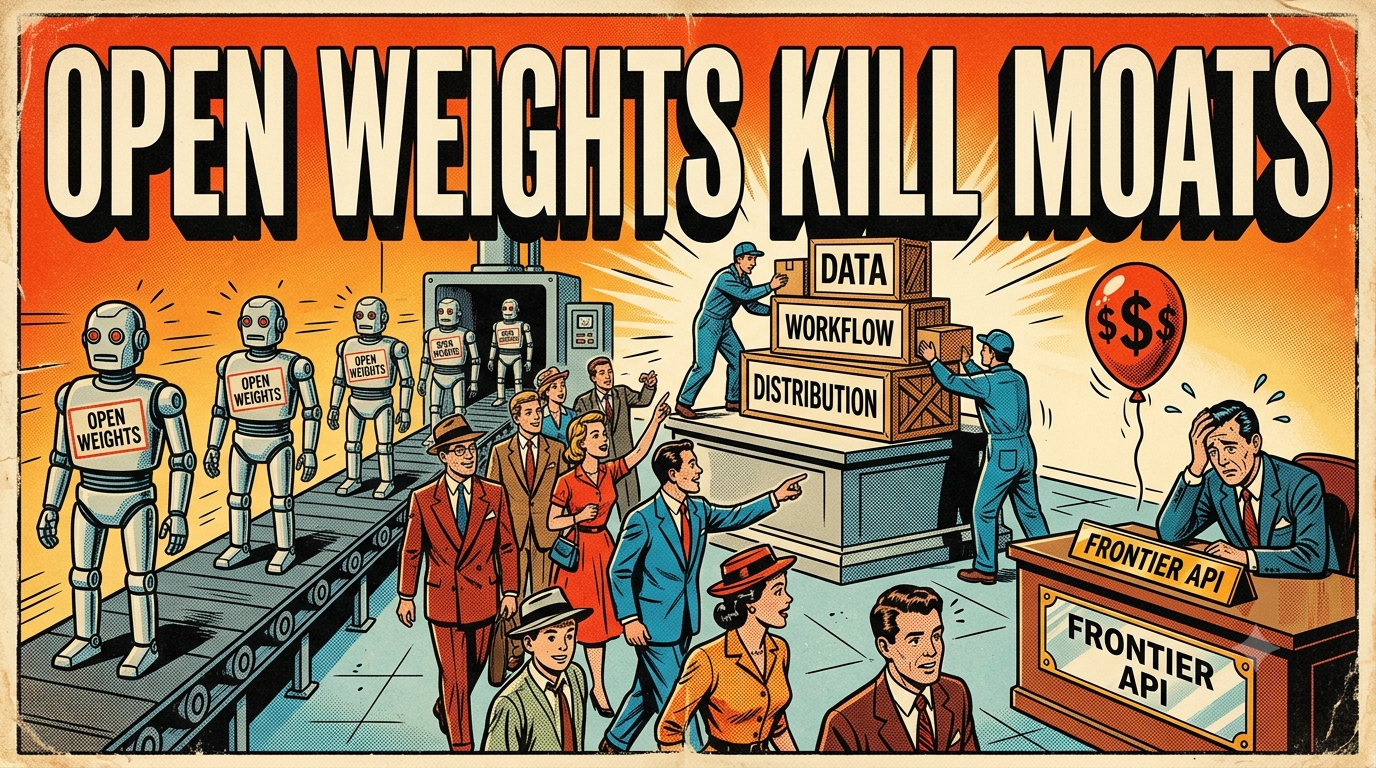
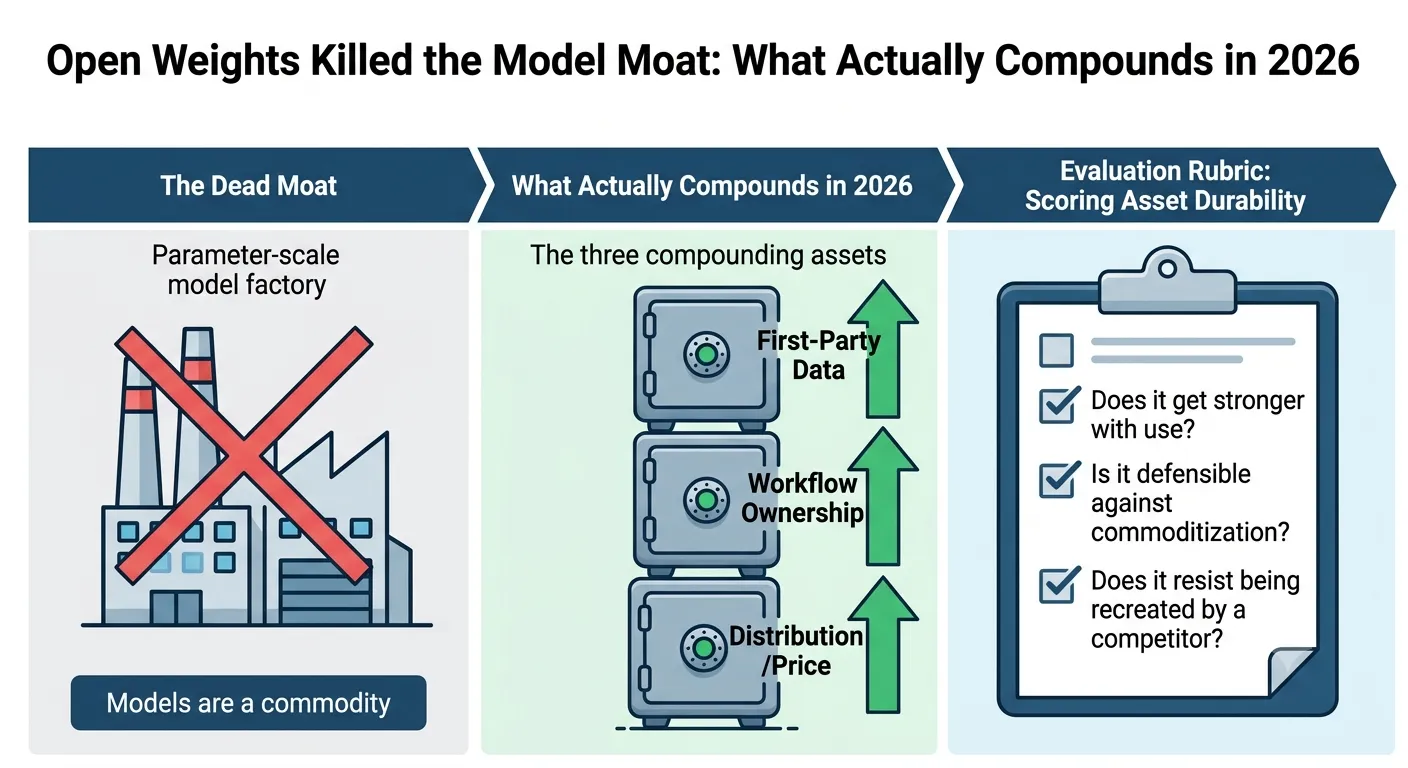
- Open weights and the price war commoditized model access; parameter scale no longer differentiates competitors.
- First-party data compounds only when it is captured in the loop of actual usage, not warehoused for training runs.
- Workflow ownership, not the model, is the durable integration asset: the more your product becomes the interface to the work, the harder it is to leave.
- Distribution and price are the only moats that survive commoditization; every strategy should be stress-tested against a model that is free and a competitor that is faster.
There is a moment in every technology shift when the obvious question stops being the right question. In AI, that moment arrived sometime in the last quarter. The obvious question was always: who has the best model? The right question now is: who cares?
The price data tells the story plainly. OpenAI cut GPT-5.6 Luna to $0.20 per million input tokens and $1.20 per million output tokens on July 30, three weeks after launch, and called it a routine adjustment. Moonshot’s Kimi K3 ships with open weights at 2.8 trillion parameters. DeepSeek V4 Flash, at 13 billion active parameters, beats models twenty times its size on agent benchmarks. KPMG’s Q1 2026 pulse survey found 68% of leaders now cite access to lower-cost, high-fidelity models as a top factor shaping their AI strategy.
This is what a commodity looks like. The weights stopped being scarce, and when the weights stop being scarce, the moat built on the weights stops being a moat.
The companies that built their AI strategy around owning the best model are now in the same position as a factory owner who spent five years perfecting a machine that everyone else can now buy at Home Depot. The machine is still useful. It just is no longer a competitive advantage.
So what actually compounds? If the model is a commodity, the defensible assets must live somewhere else. They live in three places, and they are not the places most strategy decks point at.
The Weight Commoditization Timeline
Let me be precise about what happened, because the sequence matters.
In 2024, the model was the product. Frontier labs competed on benchmark scores, and enterprises paid a premium for the top of the leaderboard because the gap between frontier and open was real. Llama 3 was good; GPT-4 was better. You could justify the API bill with a spreadsheet.
In 2025, the gap started closing. Open-weight models from Mistral and Qwen reached the point where most production workloads could not tell the difference. The benchmarks that still showed a gap were increasingly measuring things that did not matter to the average business workload. Enterprises began asking the procurement question out loud: why am I paying twenty times more for a model that answers my support tickets marginally better?
Today, the price war finished the job. When Kimi K3 ships open weights and immediately forces a pricing response from OpenAI, when DeepSeek V4 Flash beats its own flagship on agent benchmarks after a post-training pass, when every major provider cuts prices within weeks of each other’s releases, the model layer has officially commoditized. Gartner predicts that by 2028 over half of the GenAI models enterprises use will be domain-specific and self-hosted. The trend line is not subtle.
The strategic error is not failing to see this. Everyone can see it. The error is drawing the wrong conclusion from it. The conclusion most leaders draw is: models are a commodity, so the value is in the application. That is true and useless. Every competitor draws the same conclusion, and applications built on commodity models are themselves commoditized within a quarter. The question is not what layer is valuable. It is what asset resists commoditization.
The Three Assets That Actually Compound
I have been studying which assets held their value in previous commoditization waves, and then checking whether AI has an equivalent. Three pass the test.
First-Party Data, Captured in the Loop
The first asset is first-party data, but not the kind you already have. The data that compounds is the data you capture from the moment your AI system touches real work. Every request, every correction, every escalation, every case where a human overrode the model’s answer. That data is a flywheel: the system gets more usage, which produces more correction data, which makes the system better, which justifies more usage.
Here is the catch. This only works if your system is in the production loop. A model evaluated on a benchmark does not produce this data. A model used by three pilot teams does not produce enough of it. The compounding only starts at scale, and it only compounds for the company that owns the workflow. This is why the pilot-perpetuity pattern is so destructive. Every pilot that never reaches production is a flywheel that never spins.
The reason this data is a moat is that it is invisible. It is not in any public benchmark. It cannot be scraped. It is the residue of your specific users making your specific mistakes, and it makes your model behave better on your specific workload than a general-purpose frontier model tuned for the average case.
That said, this is a workload-specific advantage, not a universal one. For the novel, high-stakes, or loosely-specified problems that show up outside your well-trodden workflow, the frontier lab’s much larger training and safety investment is exactly what you want, and no amount of first-party correction data closes that gap on day one. The right read is not “small fine-tuned models beat frontier models,” it is “the workload determines which asset wins,” and most portfolios need both.
Workflow Ownership
The second asset is the workflow itself. The company that becomes the interface between the user and the work owns the switching costs.
Think about what happened to email. The protocol is open. The software is commodity. Yet switching email providers remains painful because your identity, your history, and your relationships live in the system. The product became the container for the work, and the container became the moat.
The AI equivalent is already visible. The companies winning in agentic AI are not the ones with the best agents. They are the ones whose agents are embedded in the actual workflow, connected to the actual systems, configured with the actual permissions, and trained on the actual history of the organization. An agent you have to configure from scratch is a commodity. An agent that already knows your incident response process, your approval chains, and your data warehouse schema is infrastructure.
This is the real reason MCP and the agent-API ecosystem matter. They do not commoditize the workflow. They commoditize the connections, which makes the workflow container more valuable, because the container is now the only thing that is not standard.
Distribution and Price
The third asset is the oldest one: distribution. In a world where the model is free and every feature is copied within a quarter, the company that reaches the user first and cheapest wins. This is not glamorous. It is the lesson of every SaaS wave, and it keeps being true.
The price war actually helps the companies that built for distribution. When your unit economics are driven by your ability to reach and retain users rather than by a model-rental bill, the collapse in model prices is a tailwind. Every price cut from OpenAI is a subsidy to the companies with distribution. The companies without distribution just watch their competitors’ margins improve.
The Evaluation Framework
Let me give you a practical test, because strategy frameworks are only useful when they change decisions.
Take every project in your AI portfolio and ask three questions:
What happens to this project if the model it uses becomes free tomorrow? If the answer is that the economics collapse or the differentiation evaporates, the project has no moat. Most pilot projects fail this test immediately.
Does this project capture new data that only it can capture? If the data it generates is the same data any competitor with the same model would generate, it is not compounding. The correction data, the escalation data, the telemetry of real work, that is the asset.
Is the value created inside the workflow or next to it? A tool that sits beside the workflow can be swapped. A system that becomes the workflow cannot. The second one compounds; the first one is a feature.
This is the lens I would apply before approving any new AI investment. It is a harsh lens. Most AI investments today do not survive it. That is the point. The money that used to go to model parity should go to the assets that resist commoditization.
What This Means for the AI Leaders
The CAIO role has changed because of this shift. The first generation of CAIOs spent their time picking models and negotiating API contracts. That was the job when the model was the product. It is not the job anymore.
The job now is to make sure the organization’s AI systems are in the production loop, capturing compounding data, and embedded in workflows that cannot be pried out. The CAIO who spends all year comparing leaderboards is managing the wrong layer. The CAIO who spends wiring AI into the operating model, the data capture, and the distribution channels is building the only moats that still exist.
Deloitte’s 2026 survey found only 21% of organizations have mature governance for autonomous agents while 74% plan deployment within two years. That governance gap is not a compliance problem. It is a moat problem. The organizations that figure out how to run agents safely and at scale will capture the compounding data that comes with real deployment. The ones that stay in pilot purgatory will hand that data to their competitors.
The Honest Summary
The moat built purely on parameter scale is gone for commodity-tier work, and every price cut and open-weight release confirms it. That does not mean the frontier layer stopped mattering. It means the two layers now do different jobs: frontier labs keep pushing the capability ceiling and carry the safety, alignment, and compliance investment that a self-hosted stack has to build on its own; open weights make the commodity layer cheap enough that competing on parameter count alone stops being a strategy.
What survives, on either layer, is boring. First-party data captured in the loop. Workflow ownership that creates switching costs. Distribution that turns falling model prices into margin. None of these show up on a leaderboard. All of them show up on a balance sheet.
The companies that treat AI as a way to build these assets will be hard to displace, whether they route the underlying model calls to an open-weight deployment, a frontier API, or both depending on the task. The difference is not which model family they picked. It is what they build on top of it.