· Strategy · 10 min read
The Valuation of Open Weights: The Intelligence Supply Chain
Open source models are transforming AI from a variable SaaS cost into a strategic capital asset. Discover why owning the weights is the key to Sovereign AI and a 70% reduction in long-term TCO.

There is a specific kind of mistake that companies make when they first encounter a new technology. They try to fit it into an existing line item on their budget. In the early days of the internet, businesses treated websites as marketing collateral, like a digital brochure. They did not realize that the web was actually the new storefront, the new distribution channel, and eventually, the entire business model.
We are seeing a similar category error today with the valuation of open weights in the artificial intelligence economy.
The prevailing narrative among technology executives is that open weights (models like Llama 3, Gemma 2, or Mistral v0.3) are simply a “cheaper alternative” to proprietary APIs. It is a view that sees the model as a commodity, a way to avoid the per-token pricing of a closed-source provider. This is true, but it is also the least interesting part of the story.
If you view open weights through the lens of a procurement officer, you see a discount. But if you view them through the lens of an architect or a CFO, you see something much more profound: a fundamental shift from variable operating expenses (OpEx) to fixed capital assets (CapEx).
This is a move toward what I call the Intelligence Supply Chain. It is the realization that in an AI-native world, intelligence is a raw material. And just as a manufacturer would never outsource 100% of their critical raw material supply to a single, capricious vendor who can change prices or deprecate the quality of that material overnight, a modern enterprise cannot afford to outsource the core weights of their intelligence.
The Problem with Renting Intelligence
When you rely exclusively on a closed API, you are renting intelligence. Renting is fantastic for speed. It allows you to prototype an application in a weekend. You do not need to worry about VRAM, CUDA versions, or the thermal characteristics of an H100. You just call an endpoint and receive a JSON response.
But renting has three silent failures that eventually hit every scaling enterprise.
First, there is the issue of Policy Drift. A proprietary provider can (and will) update their safety filters, their alignment tuning, or their quantization methods without your consent. Suddenly, the prompt that worked yesterday returns a refusal today. Your application breaks, but you have no visibility into why. You are at the mercy of a black box.
Second, there is the Data Egress Tax. To use a closed model, you must send your proprietary data—the very thing that constitutes your competitive moat—out of your VPC and into the servers of a third party. While enterprise agreements exist to mitigate the risk, the architectural complexity of ensuring compliance across global regions is a significant drag on velocity.
Third, and perhaps most importantly, there is Margin Compression. APIs scale linearly. If your business grows, your token bill grows in lockstep. You never achieve the economies of scale that traditionally drive software margins. You are effectively paying a permanent tax to the model provider, one that limits your ability to reinvest in your own product innovation.
The Capitalization of Open Weights
Open weights change the math. When you download the weights of a model, you have acquired an asset. It is a static, immutable file. It does not change unless you choose to change it.
This is where the transition to CapEx begins. Transitioning to open weights requires an upfront investment. You must provision private infrastructure (like GKE clusters on GCP), you must optimize your inference stack (perhaps using Pallas kernels or TensorRT), and you must hire the engineering talent to maintain the system.
This looks expensive on day one. But as your usage scales, the marginal cost of a single inference request begins to plummet. For high-volume enterprises, moving from a proprietary API to a self-hosted Llama 3 or Gemma 2 instance can result in TCO reductions of 70% to 85%.
But the real valuation is not found in the cost savings. It is found in the ability to fine-tune.
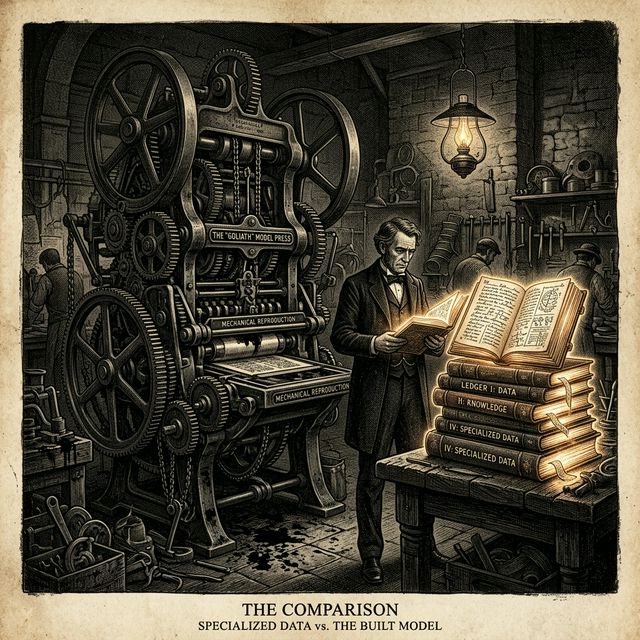
Consider the case of a company like Intuit. They did not just use a general-purpose model for their financial tasks. They took open weights and fine-tuned them on their massive, proprietary dataset of tax law, accounting principles, and user behavior. The result was a model that significantly outperformed the largest closed-source models in their specific domain, while being a fraction of the size.
This is the “Intelligence Supply Chain” in action. By owning the weights, Intuit transformed a generic commodity into a specialized tool that they alone possess. They moved from being a consumer of AI to being an operator of AI.
Sovereign AI: The Executive Mandate
For technology leaders, the move toward open weights is ultimately an exercise in sovereignty. Sovereign AI is the capacity for an organization to independently develop and deploy its intelligence systems using its own infrastructure and data.
In the 2010s, “Digital Transformation” was about moving to the cloud. In the 2020s, “AI Transformation” is about moving the compute to the data.
When you run open weights within your own GCP project, the data never leaves your boundary. You can use Confidential Computing features to ensure that even the memory of the GPU is encrypted. You can use GKE to scale your inference nodes closer to your users in specific regions to hit sub-100ms latency targets—something that is physically impossible when your request has to round-trip to an external API provider’s central hub.
This level of control is a prerequisite for the enterprise. A bank cannot have its core reasoning engine “deprecated” by a startup in San Francisco. A healthcare provider cannot risk patient data crossing an unmanaged boundary for a summarization task.
Sovereignty is not just a security preference; it is a business continuity requirement.
How to Value the Shift
If you are an executive trying to justify the move to open weights, do not just look at the token bill. Look at the three pillars of valuation:
- Asset Moat: How much more valuable is your company if you own a fine-tuned reasoning engine that no competitor can replicate?
- Tail Latency Control: What is the business impact of reducing the 99th percentile latency from 3 seconds to 200 milliseconds by co-locating compute and data?
- Governance Stability: What is the cost of a 24-hour outage or a major policy drift on a proprietary API?
We are entering an era where the most successful companies will be those that manage their intelligence supply chain with the same rigor that a car manufacturer manages their lithium supply. They will use closed APIs for exploration and prototyping, but for their core, revenue-generating workflows, they will insist on ownership.
They will realize that the weights are not just files. They are the factory. And in a world of silicon and code, you want to own the factory.
The “Linux Moment” for Artificial Intelligence
To understand the valuation of open weights, we have to look back at the history of the operating system. In the 1990s, the idea that a company would run their mission-critical production databases on a “free” operating system like Linux was considered an unacceptable risk. Proprietary Unix vendors sold safety, support, and a single neck to wring.
But Linux won because it provided something that no proprietary vendor could: transparency and the ability to modify the internal code to suit specific hardware profiles.
Open weights are the Linux of the AI era. Proprietary models are like the mainframe era—powerful, locked-down, and controlled by a few central entities. Open weights represent the decentralization of intelligence. When you have the weights, you are no longer just a “user” of a technology; you are a participant in its evolution. You can prune the model to reduce its size, you can quantize it to fit into specific instance types, and you can merge it with other models to create new, hybrid capabilities.
Blueprint for Sovereign AI
Moving from an API-only strategy to a Sovereign AI strategy requires a specific architectural blueprint. It is not just about “spinning up a VM.” It is about building a secure, scalable factory for inference.
The cornerstone of this blueprint is Google Kubernetes Engine (GKE). GKE provides a mature environment for managing GPU and TPU workloads at scale. By using GKE, you gain access to features like Multi-Instance GPU (MIG) on Nvidia RTX 6000 Pro, allowing you to split a single physical GPU into multiple smaller slices to serve different departmental LoRA adapters without the overhead of multiple full instances.
For data-sensitive workloads, the shift to Confidential Computing on is non-negotiable. Confidential VMs and k8s nodes allow you to encrypt data in use, including the data sitting in GPU memory. This effectively nullifies the traditional security objection to AI: that the model “sees” the data. In a confidential enclave, even the host OS cannot peer into the inference transaction.
Then there is the issue of Data Gravity. One of the biggest hidden costs of AI is “egress” and “ingress”—the cost and latency of moving data between your database and your model. By hosting open weights in the same project as your object buckets, you eliminate the network hop. You are moving the intelligence to the data, rather than the data to the intelligence.
Modeling the TCO: CapEx vs. OpEx
Let us look at the raw economics of the “Rent vs. Buy” decision.
A high-frequency agentic workflow in a large enterprise might generate 5 million tokens per day. On a top-tier proprietary API, this could easily cost 100 per day in variable costs. Over a year, that is a $30,000+ line item for a single small-scale application.
Compare this to the “Buy” model. A single GPU Enabled instance costs roughly 13,000 per year. That single instance can serve millions of tokens per day with significantly lower latency than an external API.
But the math gets even better at scale. As you add more applications, your infrastructure costs do not scale linearly. You can use Continuous Batching and vLLM v0.6+ to squeeze more throughput out of the same silicon. You can use Spot Instances for non-critical background summarization tasks, reducing your costs by another 60% to 90%.
The break-even point for most enterprises is remarkably early—often within the first 6 to 9 months of operation. After that point, every additional token you generate is effectively “free” compared to the API model. You have moved the intelligence from a cost center to an asset that contributes to your operating margin.
The Intelligence Supply Chain: A New Strategic Pillar
The final valuation metric is Strategic Resilience. We have seen what happens when global supply chains for physical goods break down. We saw it with semiconductors, with energy, and with logistics.
In the next five years, the most critical supply chain for a company will be its intelligence supply chain. If your entire product depends on a model that you do not own, you have a massive, unmanaged risk on your balance sheet.
By investing in open weights and the infrastructure to run them, you are securing your future. You are building a system that can run in disconnected environments, that can scale across global regions without permission, and that can be fine-tuned to your unique, competitive “Alpha.”
The valuation of open weights is not about the “free” price tag. It is about the transition from being a tenant in someone else’s digital empire to being the sovereign ruler of your own.
In the AI era, you do not want to be a customer. You want to be an owner. Use Gemini 2.5 Pro for your massive, 1M+ token context reasoning tasks, but for your high-frequency, high-velocity production core, look at the weights. Look at what happens when you own the intelligence.
You might find that it’s the most valuable move your company ever makes.