· AI Engineering · 5 min read
Architecting the AI Gateway: Centralizing Token Routing and Fallbacks
Why enterprise teams are moving away from direct API calls and building internal proxy gateways to handle rate limits, caching, and automatic vendor failovers.
- Connecting application code directly to foundation model APIs (like OpenAI or Gemini) creates a massive single point of failure and vendor lock-in.
- An AI Gateway acts as a reverse proxy, intercepting all requests to provide unified authentication, usage tracking, and rate limiting.
- Gateways enable automatic failover routing; if Claude 3.5 Sonnet hits a rate limit, the Gateway can seamlessly retry the prompt against GPT-4o without breaking the client.
- Semantic caching at the Gateway level drastically reduces API costs and latency for repetitive queries across your entire organization.
If you look at the architecture diagram of almost any enterprise AI application built in 2023 or 2024, you will see a direct line drawn from the application backend straight to a foundation model provider. The backend code hardcodes the API keys, handles the specific payload structure for that vendor, and deals with the inevitable timeout errors using basic retry logic.
This works when you are building a prototype or a single internal tool. It is an absolute disaster when you are scaling AI across a multi-team enterprise.
When you have twenty different microservices all making direct calls to external APIs, you lose observability. You cannot accurately track which team is burning through your token budget. If OpenAI has an outage, all twenty of your services go down simultaneously. If you decide to switch a workload to Gemini because it handles context windows better, you have to refactor the application code itself.
The solution is an architectural pattern borrowed directly from the microservices era: the API Gateway, reimagined for large language models. Today, we are going to look at why you need an AI Gateway, and how to architect one.
The Problem with Direct Integrations
When an application integrates directly with an LLM provider, it inherits all the volatility of that provider. Foundation models are currently the least reliable layer of the modern tech stack. Latency spikes are common, rate limits are aggressively enforced, and providers occasionally deprecate models with very little warning.
Furthermore, every provider has a slightly different SDK and payload structure. Anthropic’s message format is different from OpenAI’s, which is different from Google’s. If your application code is tightly coupled to these specific SDKs, you are locking yourself into a vendor at the code level.
Architecting the AI Gateway
An AI Gateway sits between your internal applications and the external foundation models. It acts as a unified entry point, a reverse proxy specifically designed to handle the quirks of LLM traffic.
Instead of calling api.openai.com, your internal services call gateway.internal.corp/v1/chat/completions. They pass a standard payload, and the Gateway handles the translation, routing, and execution.
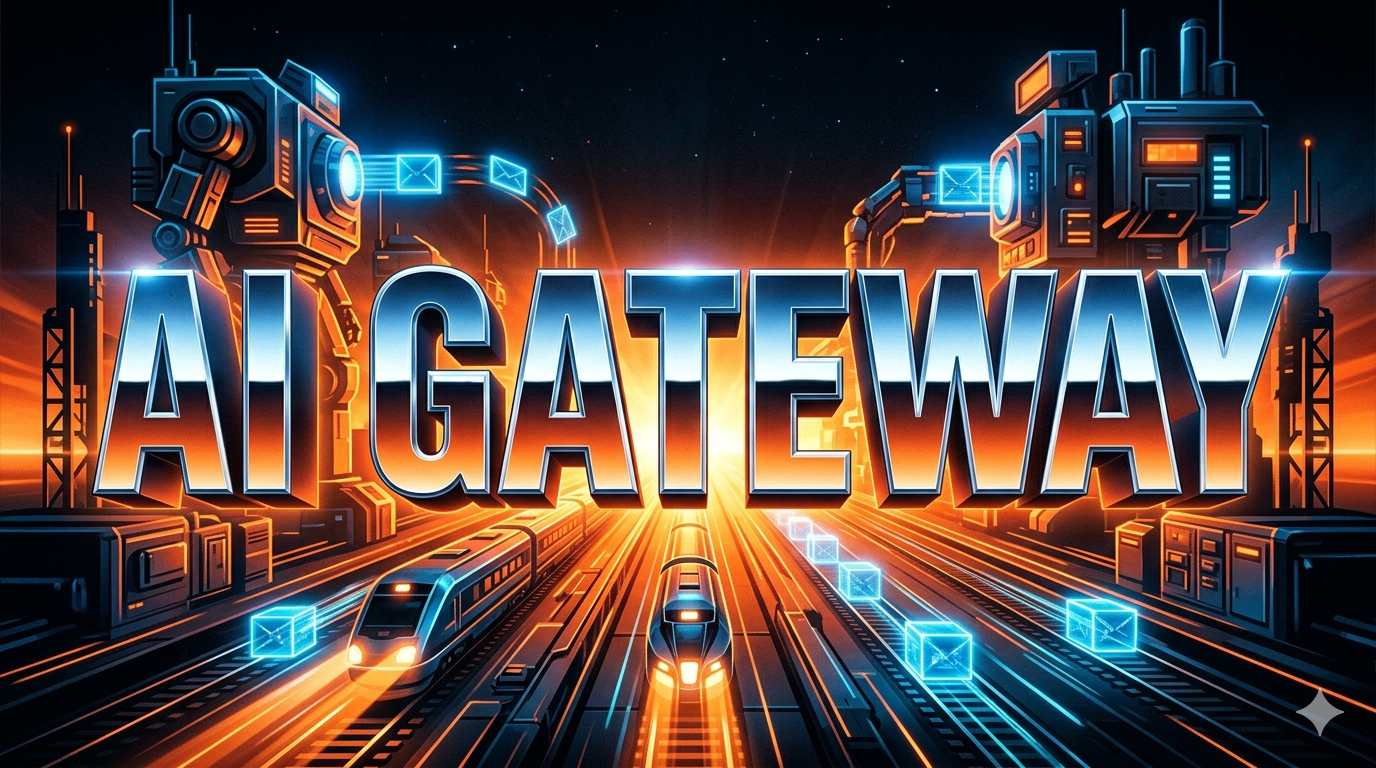
architecting-ai-gateway AI architecture requests from internal microservices. The Gateway applies semantic caching, checks access controls, and then dynamically routes the request to either OpenAI, Google, or Anthropic based on current availability and latency._
Here are the core components a production-grade AI Gateway must implement:
1. Unified Authentication and Telemetry
The most immediate benefit of a Gateway is visibility. Instead of distributing external API keys to every team, the Gateway holds the master keys securely in a secrets manager. Internal teams authenticate with the Gateway using their standard corporate SSO or internal tokens.
The Gateway logs every request. It intercepts the payload, counts the input and output tokens, and logs them against the specific team or service that made the request. For the first time, your FinOps team can see exactly which microservice is responsible for the $50,000 monthly API bill.
2. Automatic Vendor Failover
This is where the Gateway becomes a critical reliability layer. If your primary model is GPT-4o, and the OpenAI API starts returning 503 errors or hitting rate limits, a direct integration will simply fail.
An AI Gateway can catch that 503 error, instantly translate the OpenAI payload into an Anthropic payload, and route the request to Claude 3.5 Sonnet. The client application has no idea this failover occurred; it simply receives the expected response. You have decoupled your application’s uptime from any single vendor’s uptime.
3. Semantic Caching
Standard HTTP caching uses exact string matching. This is useless for LLMs, where the same semantic question might be asked in twenty different ways.
An AI Gateway can implement a Semantic Cache layer (often backed by Redis and a lightweight embedding model). When a request comes in, the Gateway embeds the prompt and checks the vector database. If it finds a highly similar prompt that was answered recently, it returns the cached response instantly.
This skips the external API call entirely. For applications with high query overlap (like internal knowledge bases or customer support bots), a semantic cache at the Gateway level can reduce token costs and latency by over 30%.
The Build vs. Buy Decision
Two years ago, if you wanted an AI Gateway, you had to build it yourself using NGINX and custom Lua scripts or Go services. Today, the ecosystem has caught up.
Open-source solutions like LiteLLM offer fantastic out-of-the-box routing and translation layers. Managed services from Cloudflare (AI Gateway) and Portkey provide enterprise-grade observability and caching without the infrastructure overhead.
Whether you build or buy, the architectural mandate remains the same: stop hardcoding external LLM APIs into your backend services. Abstract the volatility, centralize the telemetry, and implement a routing layer. The AI Gateway is not an optional optimization; it is a foundational requirement for enterprise AI infrastructure.