· AI Engineering · 6 min read
Chunked Prefill: Solving the Noisy Neighbor Problem in Inference
When a massive prompt stalls your entire inference server, you have a noisy neighbor problem. The solution requires rethinking how we process context with Chunked Prefill.
- Continuous batching inference servers can be brought to a halt by a single massive input prompt, causing extreme tail latency for all other users.
- This "noisy neighbor" problem occurs because the compute-heavy prefill phase blocks the execution of the memory-bound decode phase for existing requests.
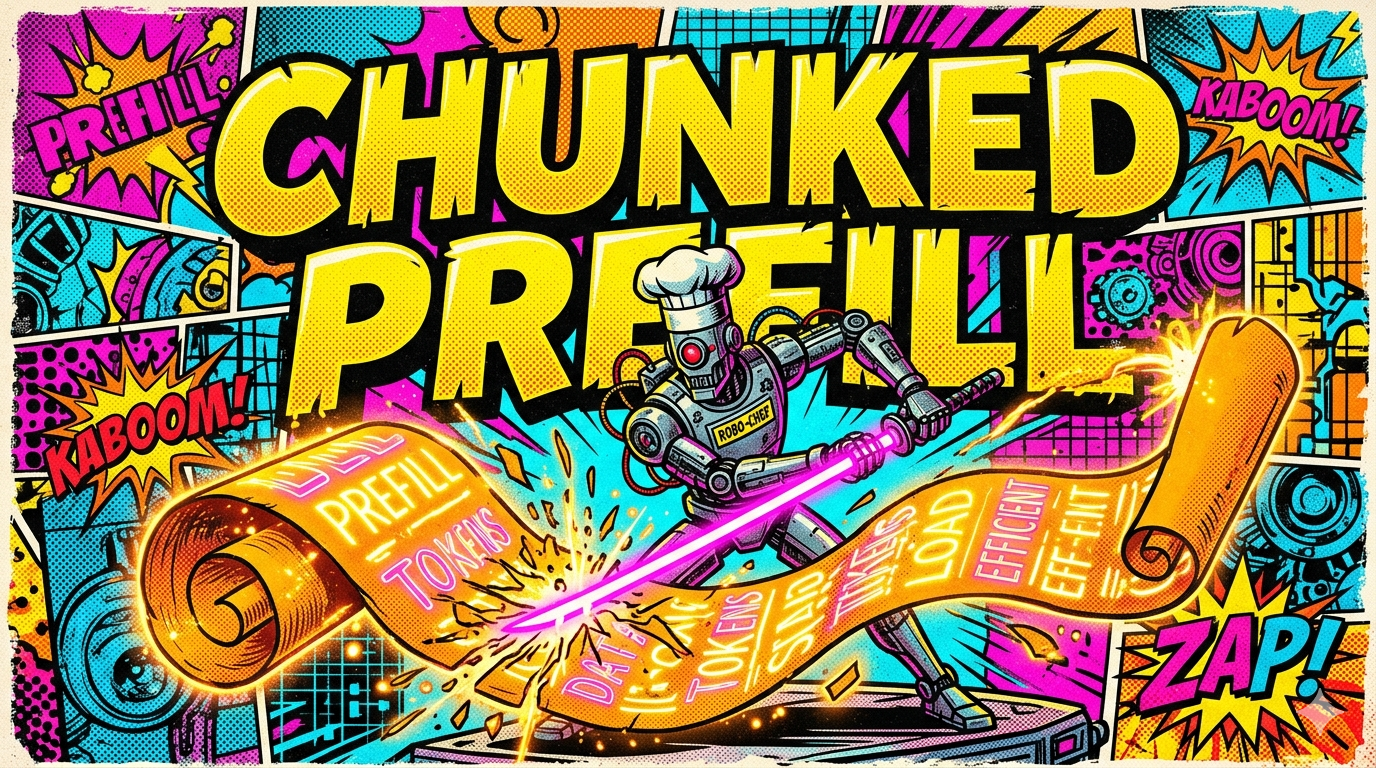
- Chunked Prefill solves this by slicing massive prompts into smaller segments, interleaving their computation with the decode steps of other requests.
- Implementing this requires careful management of the KV cache and a deep understanding of your serving engine's scheduling heuristics.
If you run a high-traffic AI application, you will eventually encounter the “noisy neighbor” problem. It is an insidious, frustrating issue that ruins your latency metrics and infuriates your users.
Here is the scenario. You have a robust continuous batching inference server running smoothly. You are processing dozens of concurrent requests, generating tokens at a steady clip. Your Inter-Token Latency (ITL) looks great.
Then, a power user connects. They don’t just ask a question; they upload a 200,000-token PDF of a legal contract and ask the model to summarize it.
Suddenly, your entire server stalls. The users who were happily receiving their fast, steady stream of tokens see their screens freeze. The ITL spikes from 50 milliseconds to 3 or 4 seconds. The system grinds to a halt.
Why did one large request destroy the performance of everyone else on the server?
Because you didn’t chunk your prefill.
The Architecture of the Stall
To understand the fix, you need to understand exactly what happens inside the inference engine when that massive document hits the queue.
As I discussed in a previous post, inference has two distinct phases: Prefill and Decode.
When a continuous batching system (like vLLM or standard Vertex AI endpoints) receives a new request, its scheduler has to make a choice. It can either keep running the decode phase for the existing requests, or it can pause the decode phase and run the prefill phase for the new request to get it started.
Historically, schedulers prioritize TTFT (Time To First Token). They want to acknowledge the new request as quickly as possible. So, the scheduler pauses all the ongoing generations and feeds that massive 200k-token prompt into the compute units.
The prefill phase is an enormous matrix multiplication. It requires computing the Key-Value (KV) cache for every single token in that document. For a massive prompt, this computation takes a significant amount of time. It monopolizes the GPU or TPU tensor cores.
While the hardware is grinding through that massive prefill, the other 50 users on the server are waiting. Their decode requests are starved of compute. They are the victims of the noisy neighbor.
Enter Chunked Prefill
The solution to this problem is a technique called Chunked Prefill.
Instead of treating the prefill phase as a single, indivisible, monolithic operation, we slice the massive prompt into smaller, manageable chunks.
Let’s say we configure our engine with a chunk size of 4,096 tokens. When the user uploads their 200k-token legal document, the scheduler does not attempt to process the whole thing at once.
It takes the first 4,096 tokens and computes the KV cache for that chunk. Because it’s a small chunk, this operation finishes very quickly.
Once that chunk is processed, the scheduler yields. It switches contexts back to the decode phase and generates the next token for all the other 50 users on the server. Then, it switches back and processes the next 4,096-token chunk of the massive document.
Interleaving Compute and Memory
This is where the magic happens. We are deliberately interleaving the prefill chunks with the decode steps.
Why is this so effective? Because, as we know, prefill and decode stress the hardware in entirely different ways.
Prefill is compute-bound. It uses the tensor cores heavily. Decode is memory-bandwidth bound. It spends most of its time waiting for data to load from HBM (High Bandwidth Memory), leaving the compute units largely idle.
By interleaving them, we achieve maximum hardware utilization. While the memory controllers are busy fetching the weights for the decode steps, the compute units can be crunching the matrix multiplications for the next prefill chunk. We are hiding the latency of the prefill behind the memory wait times of the decode.
The Trade-offs and Implementation
Chunked prefill is incredibly powerful, but it is not a silver bullet. There are trade-offs you must accept.
The most significant trade-off is that the user who uploaded the massive document will experience a longer Time To First Token (TTFT). Because you are pausing their prefill to serve other users, it will take longer for them to see their first output.
However, this is almost always the correct architectural decision. You are sacrificing the TTFT of one heavy user to protect the Inter-Token Latency (ITL) of fifty light users. You are containing the blast radius of the noisy neighbor.
Implementing this requires configuring your inference engine correctly. If you are running open-source frameworks like vLLM or SGLang, you must explicitly enable chunked prefill and carefully tune the chunk size.
If you set the chunk size too large, you still get latency spikes. If you set it too small, the overhead of constantly switching contexts between prefill and decode will degrade your overall throughput. The optimal size depends entirely on your specific hardware (e.g., the specific generation of TPUs or GPUs) and the average profile of your traffic.
Building Resilient Systems
When you move from building prototypes to operating enterprise infrastructure, the challenges shift. You are no longer just trying to get the model to output a correct answer. You are trying to ensure that the system remains stable, predictable, and fair under extreme load.
The noisy neighbor problem is a classic distributed systems failure mode applied to AI inference. Chunked prefill is the engineering solution. It forces us to stop treating LLMs as magical black boxes and start treating them as physical compute workloads that must be rigorously scheduled and managed.
This is what real AI engineering looks like.