· Strategy · 9 min read
Cloudflare Crawl Budget: Monetizing AI-Driven Bot Traffic
Cloudflare crawl budget monetization: strategic analysis of how AI crawlers consume crawl budgets, the emerging monetization models, and what website operators need to know about AI-driven bot traffic in 2026.
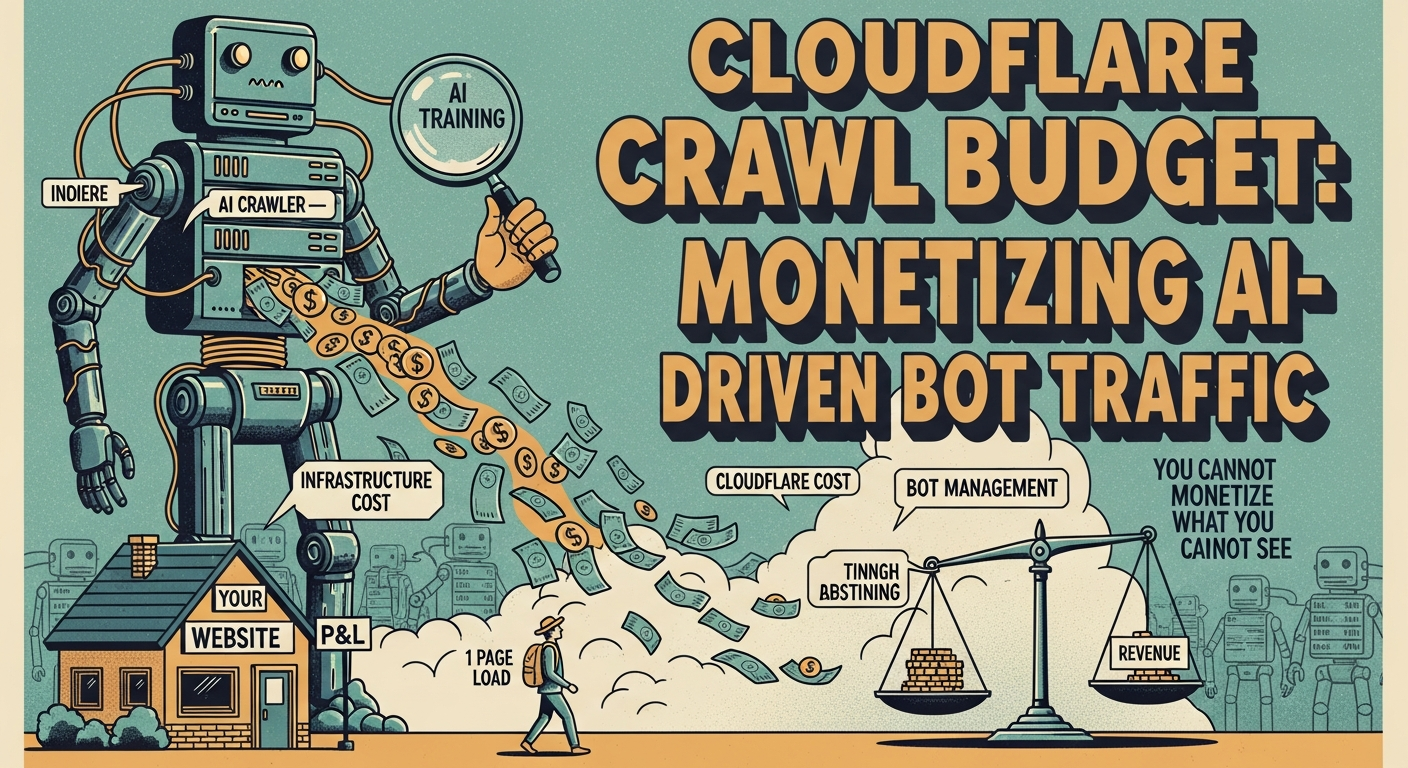
- AI crawlers consume exponentially more crawl budget than human visitors. A single AI training request can trigger thousands of page fetches across your site.
- The traditional blocking model for AI bots is failing because it eliminates traffic entirely rather than creating value from it.
- Monetization models are emerging around crawl attribution, rate-limited access, and structured data licensing.
- The organizations that win at this are the ones that treat AI crawl requests as a revenue opportunity, not a denial-of-service attack.
There is a number that every website operator should be watching right now that most of them are not.
How many of your daily page requests come from AI crawlers.
A year ago the answer was a fraction of one percent. Today it is double digits in many sectors. For content-heavy sites it is already approaching thirty percent of total traffic.
The direction of travel is not debatable. AI crawler bot traffic is growing faster than any other visitor category on the internet. It is not a trend. It is a structural shift in how AI data is consumed from the web.
The question is not whether this traffic will continue to grow. The question is whether the operators of the sites that AI crawlers are consuming will capture value from it or simply absorb it as a cost.
The Scale Mismatch
Let me explain why this is a problem for any website that cares about infrastructure costs.
A human visitor loads a page, reads it for an average of two to thirty seconds, then leaves. That is one HTTP request per page. Maybe a few more if they click through to related content. The cost model is straightforward because the traffic volume matches the value model.
An AI crawler operates differently. A single AI training or indexing request can trigger dozens of page fetches across a single website. The crawler does not read content in seconds. It processes and stores it. Once the data is cached locally by the crawler’s organization, the same content may be fetched again and again for different model training runs, indexing updates, and verification passes.
This means that a single AI organization’s crawler can generate more requests against your infrastructure than your most popular human visitor generates in a month. There is no rate limiting that naturally constrains this behavior. The crawler sees a publicly accessible URL and treats it as data.
The cost of processing those requests is real. Bandwidth. Server CPU. Database queries. CDN egress. Every one of those requests consumes real infrastructure. The difference is that the infrastructure is not being used to serve customers who pay you money. It is being used to serve customers who do not know you exist and do not pay you anything.
This is the fundamental asymmetry. Your infrastructure costs scale with total requests. Your revenue scales only with human visitors. When AI bot traffic becomes a significant fraction of total requests, the cost-to-revenue ratio starts moving in the wrong direction.
The Blocking Trap
The instinctive response from most site operators is straightforward. Block the crawlers. Put up a robots.txt rule. Add a Cloudflare rule to deny requests from known AI bot user agents. Block at the DNS level.
Blocking has two problems.
The first problem is enforcement. Known AI bot user agents change frequently. Organizations spin up new crawlers with random user agent strings. IP-based blocking is unreliable because crawlers rotate through proxy networks and cloud infrastructure. No matter how aggressive your blocking rules are, determined crawlers will find a way through.
The second problem is strategic. Even if you could block all AI crawlers perfectly, you are unilaterally eliminating an entire category of traffic from your analytics, your engagement metrics, and your competitive positioning. Content that is indexed by AI search systems and training models becomes more discoverable, more cited, and more referenced. Blocking AI crawlers does not stop the data from being used somewhere. It just means you have no visibility into which AI systems are using it and no leverage in negotiating terms.
I have seen this play out repeatedly. A site operator blocks AI bot traffic in frustration. Six months later they discover that a competitor’s content is being cited extensively in AI-generated responses while their own content is invisible because they blocked the crawlers that feed them. The blocking decision solved an infrastructure cost problem and created a competitive visibility problem simultaneously.
The cost savings from blocking are immediate and measurable. The competitive damage is delayed and difficult to quantify. The latter tends to get more attention over time.
The Emerging Monetization Models
So if blocking is neither fully effective nor strategically optimal, what is the alternative?
The first model is crawl attribution. AI organizations that use your content need to attribute it. This attribution has value. It demonstrates data provenance, establishes citation chains, and helps maintain the quality of the trained models. Monetizing crawl attribution means building systems that can identify which AI crawlers are consuming your data, track which pages are being accessed, and generate attribution reports that can be shared with the crawling organizations as part of a commercial agreement.
The mechanism is simple. AI crawlers send HTTP requests. Those requests contain headers, timestamps, access patterns, and endpoint information. A well-designed attribution system can aggregate this information into structured reports that tell an AI organization what content they are pulling from your site, how frequently, and in what volume. That information has value. It can be the basis of a licensing agreement.
The second model is rate-limited access. Instead of blocking AI crawlers entirely, you provide them with rate-limited access through a structured API. The API endpoint serves the same content but with predictable bandwidth costs. The rate limits prevent infrastructure overload while guaranteeing that the crawler can access the data it needs for training. The commercial arrangement can be per-request pricing, monthly access fees, or tiered packages based on volume.
This model has an important structural advantage. It makes the relationship between the content provider and the AI crawler explicit. The crawler is no longer an anonymous bot consuming data silently. It is a commercial customer with a known identity, a predictable request volume, and a contractual commitment to pay for the access it receives.
The third model is structured data licensing. Rather than selling access to your entire website, you package specific datasets for targeted licensing. Product specifications, technical documentation, industry reports, and other structured content can be packaged as commercially licensed datasets. The licensing terms can include restrictions on usage rights, model fine-tuning permissions, and redistribution conditions.
This model works best for organizations that have specialized content that is particularly valuable for AI training. Technical manuals, financial data, regulatory filings, scientific papers, and industry benchmarking reports are examples of content that AI organizations actively seek because it is high-signal and well-structured.
What Cloudflare Offers Today
Cloudflare has been at the center of this conversation because it sits at the intersection of bot management and AI traffic. Their bot management product can identify and classify bot traffic with varying levels of accuracy. They have built a database of AI crawler signatures and maintain ongoing relationships with the organizations that operate them.
Their crawl management features provide visibility into how much of your traffic comes from AI crawlers. They can segment that traffic by organization, by user agent, and by access pattern. They offer rate limiting, CAPTCHA challenges, and access control that can be applied conditionally based on the type of bot detected.
This infrastructure is valuable because it provides the visibility layer that most organizations lack. You cannot monetize AI crawlers if you do not know they exist, how much traffic they generate, or which organizations are responsible. Cloudflare’s bot management products address exactly this gap.
The next step is moving from visibility to commercial activation. Visibility without a monetization strategy is a monitoring exercise. It tells you what is happening without extracting value from it. The organizations that treat this as a strategic revenue opportunity are the ones building the necessary integrations between visibility, rate limiting, and billing.
Building a Crawl Monetization Strategy
The organizations that will successfully monetize AI crawler traffic will approach this systematically rather than reactively.
Start by measuring accurately. Deploy bot classification that distinguishes between human visitors, automated crawlers, training bots, indexing bots, and adversarial bots. Quantify the volume, cost, and pattern of each category. Build dashboards that show the trend over time.
Then evaluate the strategic importance of your content for AI training. Is your content general-purpose information that AI systems can find through multiple sources? Or is your content specialized data that is difficult to obtain elsewhere? The differentiation determines your pricing leverage.
Next, design the access model. Will you provide public access with attribution tracking? Or will you require signed agreements before granting crawler access? Will you offer tiered pricing based on volume? Will you package specific datasets as licensed products? Each of these decisions shapes the economics of the relationship.
Finally, monitor continuously. AI crawler behavior changes. Organizations adjust their training strategies. New models emerge that require different data or access patterns. Your monetization strategy needs to adapt to these changes in real time.
This is not a simple engineering problem. It is a business model problem. The technology exists to measure, classify, and control AI crawler access. The missing piece is the business framework that turns access control into a sustainable revenue stream.
The organizations that get this right will have a completely new revenue category that their competitors lack. The organizations that get it wrong will absorb the infrastructure cost and watch their competitive positioning erode silently because they blocked their own visibility.
AI crawler traffic is not going away. It is only going to grow. The question each organization needs to answer is whether they will treat it as a problem or an opportunity.