· Agentic AI · 11 min read
MCP Is Eating the AI Tooling Stack: Why Anthropic's Protocol Is the TCP/IP of Agentic AI
How the Model Context Protocol is becoming the universal interoperability layer for agentic AI, and why its donation to the Agentic AI Foundation marks a Kubernetes-level inflection point for enterprise adoption.
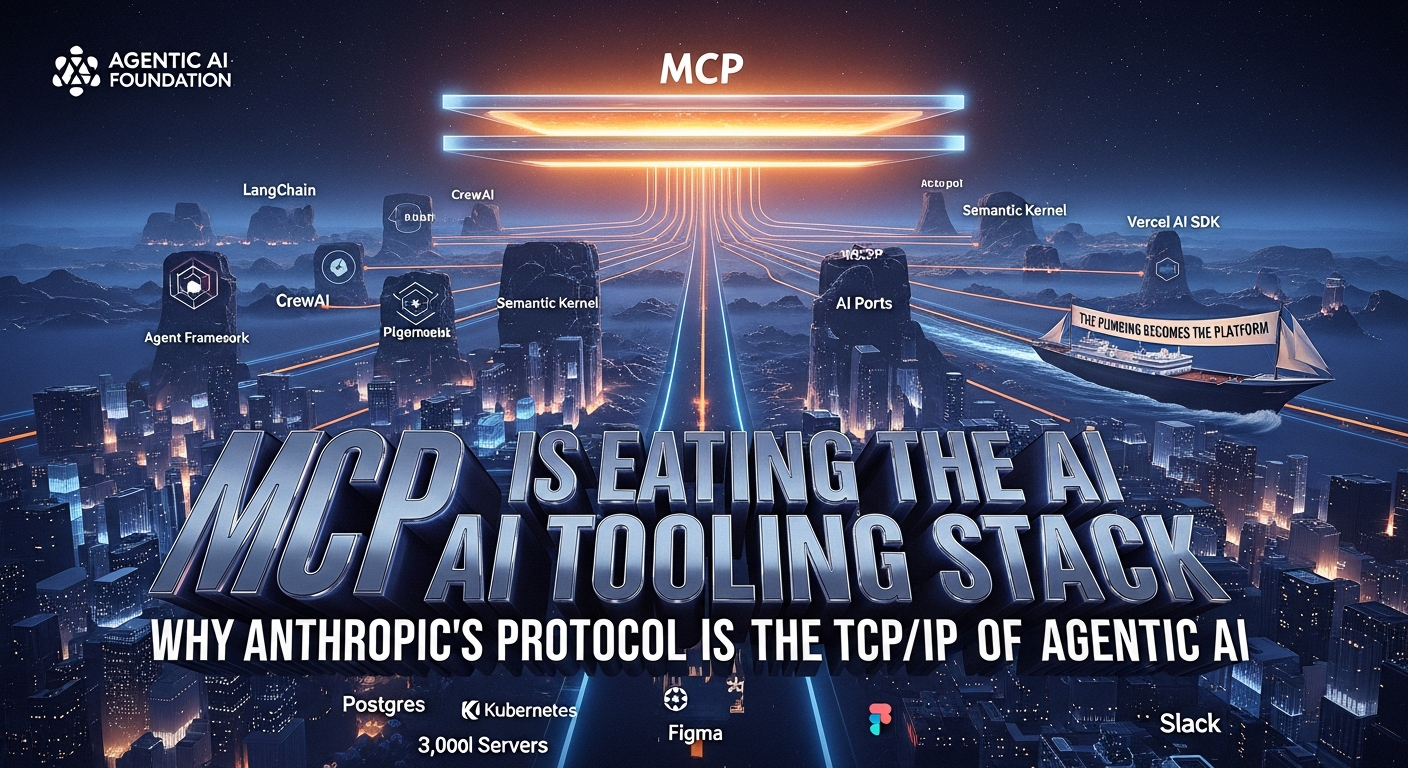
- MCP is evolving from an Anthropic-led standard into an industry-governed protocol via the Agentic AI Foundation, mirroring Kubernetes' path through the CNCF.
- Gartner's 2026 Hype Cycle for Agentic AI identifies communication frameworks (MCP, A2A) as foundational enablers, not nice-to-haves.
- Enterprise adoption is accelerating because MCP solves the interoperability problem that makes agentic AI brittle at scale.
- The protocol layer is where the economic value concentrates, analogously to how TCP/IP captured value in the early internet.
- KPMG and Deloitte both cite standardization as a prerequisite for production agentic AI, and MCP directly addresses that gap.
Every technology revolution has a moment where the plumbing becomes more valuable than the applications. In the 1990s, TCP/IP became that plumbing for the internet. In the 2010s, Kubernetes became that plumbing for cloud infrastructure. In 2026, the Model Context Protocol is becoming that plumbing for agentic AI.
And just like TCP/IP and Kubernetes before it, the critical inflection point is not the technology itself. It is the governance transition. When Anthropic donated MCP to the Agentic AI Foundation in early 2026, they triggered a shift that will reshape the entire AI tooling landscape. MCP is no longer an Anthropic protocol. It is an industry standard. That distinction matters more than any feature release.
This article is not about how MCP works at the JSON-RPC level. This is about the protocol layer, the economic dynamics of standardization, and why MCP is eating the AI tooling stack from the middle out.
The Protocol Layer Thesis
The simplest way to understand MCP’s trajectory is to look at what happened to networking in the 1990s. Before TCP/IP became universal, every vendor had their own protocol. Novell had IPX. Microsoft had NetBEUI. Apple had AppleTalk. Each protocol worked well within its own ecosystem. None of them worked across ecosystems.
The market fragmented. Developers had to write adapters for every combination. Interop was a feature you paid extra for.
Then TCP/IP won. Not because it was technically superior to every alternative (it was not). It won because it was open, simple, and good enough. The economic effect was immediate: the value in networking shifted from the protocol layer to the application layer. Companies stopped competing on proprietary transport and started competing on what they built on top of the standard.
MCP is following the same playbook.
Before MCP, every agent framework had its own tool-calling convention. LangChain had its own tool schema. Semantic Kernel had its own. Vercel AI SDK had its own. CrewAI had its own. Every time you built an agent, you had to choose a framework and lock into its tool description format. If you wanted to switch frameworks, you rewrote your tool integrations. If you wanted to use tools across frameworks, you maintained parallel implementations.
This is exactly the same problem that TCP/IP solved. MCP provides a universal contract: “Here is how tools describe themselves. Here is how tools are invoked. Here is how context is exchanged.” Any agent framework that speaks MCP can use any MCP-compatible tool. Any tool that exposes an MCP server can be consumed by any MCP-compatible agent.
The framework becomes irrelevant. The protocol becomes the interface.
Why This Time Is Different
Skeptics will point out that the AI industry has seen standardization attempts before. OpenAI’s function calling specification became a de facto standard, but it was always controlled by OpenAI. Google’s function calling spec was slightly different. The industry could never converge because every vendor wanted to control the interface.
MCP is different for three reasons.
First, the governance model. Anthropic did not just open-source the specification. They donated it to the Agentic AI Foundation, a neutral governance body modeled on the Cloud Native Computing Foundation that oversaw Kubernetes. The foundation controls the specification, the reference implementation, and the certification process. No single vendor can unilaterally change the protocol. This matters enormously for enterprise risk officers who have been burned by vendor lock-in.
Second, the scope. Function calling specifications only covered tool invocation. MCP covers the full context exchange lifecycle: resources (data that the model can read), tools (operations the model can invoke), and prompts (templates the model can use). It also includes transport-layer abstractions (STDIO for local, SSE for remote), authentication, and sampling. It is a complete protocol for the model-context boundary, not a narrow API specification.
Third, the adoption velocity. When I look at the MCP ecosystem in mid-2026, the numbers are striking. Every major agent framework supports MCP natively. Every cloud provider has an MCP gateway service. The open-source registry of MCP servers has passed 3,000 entries spanning everything from Postgres connectors to Figma design tool access to Kubernetes cluster management. The ecosystem has passed the critical mass threshold where not supporting MCP is a competitive disadvantage.
The Enterprise Standardization Imperative
Gartner’s 2026 Hype Cycle for Agentic AI places “communication frameworks” (including MCP and Google’s Agent-to-Agent protocol) at the height of the “Slope of Enlightenment,” not the “Peak of Inflated Expectations.” This is significant. Gartner is saying that protocol standardization is not hype. It is a practical requirement for production deployment.
The reasoning is straightforward. Enterprise AI governance requires observability, auditability, and control. If every agent integration uses a custom tool-calling pattern, you cannot build centralized monitoring. You cannot enforce consistent security policies. You cannot audit what tools were called and with what parameters.
MCP provides a standardized interception point. Every tool call flows through the same protocol layer. You can log it. You can rate-limit it. You can apply approval policies. You can trace it back to the originating agent and the specific user session. This is not theoretical. Companies like KPMG are already building MCP-based governance layers that sit between the agent and the tool, providing the control plane that enterprises demand.
KPMG’s 2026 research on agentic AI governance is explicit: “Governance and standardization are prerequisites for agentic AI at scale. Organizations that deploy agents without a standardized protocol layer will face significant operational risk.” They are not talking about MCP specifically, but MCP is the only protocol that currently satisfies the requirements they outline: open standard, neutral governance, transport-agnostic, and audit-capable.
Deloitte’s 2026 State of AI report echoes this warning: “Agentic AI usage is poised to rise sharply but oversight is lagging. The gap between deployment velocity and governance capability is the single greatest risk factor for enterprise AI programs in 2026.” MCP directly addresses this by providing the observability and control layer that oversight requires. When every tool invocation flows through a standardized protocol, you can build governance tooling that is protocol-aware rather than integration-specific.
The Economic Concentration at the Protocol Layer
Here is the argument that makes venture capitalists pay attention. In every technology cycle, economic value concentrates at the layer that becomes the universal bottleneck. In the mainframe era, value concentrated in hardware (IBM). In the client-server era, value concentrated in the operating system (Microsoft). In the cloud era, value concentrated in the infrastructure platform (AWS, Azure, GCP).
In the agentic AI era, value is concentrating at the protocol layer.
The logic is simple. If MCP becomes the universal interface between models and tools, then control over the protocol translates into control over the ecosystem. The Agentic AI Foundation (not Anthropic) controls the protocol, which means no single company captures the protocol rents. But the companies that build the best MCP infrastructure, tooling, and services capture the value that aggregates around the standard.
Consider the analogies. TCP/IP itself generated no direct revenue. But companies that built on TCP/IP (Cisco for routing, Akamai for content delivery, AWS for cloud services) generated enormous value. Kubernetes itself is free and open-source. But the ecosystem around Kubernetes (Red Hat for distribution, Datadog for observability, HashiCorp for security) is a multi-billion dollar market.
MCP will follow the same pattern. The protocol itself is free. The value will concentrate in:
- MCP gateway services that provide enterprise-grade routing, authentication, and rate-limiting
- MCP observability platforms that give visibility into agent-tool interactions
- MCP security scanners that validate server implementations against the specification
- MCP registry and marketplace services that help enterprises discover and manage tool integrations
- MCP certification programs that verify compliance with enterprise security requirements
This is why the donation to the Agentic AI Foundation matters economically. If Anthropic controlled MCP unilaterally, enterprises would hesitate to build their infrastructure around it. The governance transition removes that hesitation. It signals that MCP is a standard, not a product. Standards attract investment. Products attract procurement. The economics of standards are fundamentally different.
The Governance Debate
There is broad consensus that MCP is the most important infrastructure standard since Kubernetes. The debate is not about whether MCP matters. It is about whether the governance model will hold.
The concern is valid. Anthropic created MCP. Anthropic donated it to the foundation. But Anthropic remains the most significant contributor to the specification and the reference implementation. Will the foundation maintain true independence? Or will it be a rubber stamp for Anthropic’s roadmap?
This is exactly the debate that surrounded Kubernetes when Google donated it to the CNCF. Skeptics argued that Google would maintain de facto control and use the foundation as a marketing vehicle. In practice, the CNCF governance model worked. Google’s influence was proportional to its contribution, not privileged. Other vendors (Red Hat, VMware, Microsoft) became equal participants. The specification evolved through community consensus, not corporate decree.
The early signs for the Agentic AI Foundation are positive. The founding members include Anthropic, Google, Microsoft, and several independent contributors. The technical steering committee has representation across vendors. The specification development process is open and transparent. But it is early. The real test will come when the first controversial specification decision arises. Will the foundation prioritize community consensus over Anthropic’s preferences? That is the open question.
My take is cautiously optimistic. The CNCF precedent is strong. The industry has learned the lessons of open governance. And the economic incentives align: no single vendor benefits from a protocol that others distrust. The foundation’s success is in everyone’s self-interest.
Practical Implications for Developers and Architects
If you are building agentic systems, the implications of MCP standardization are concrete.
First, design your tools as MCP servers, not framework-specific integrations. This is the single most important architectural decision you can make. An MCP server works with any framework. A LangChain tool only works with LangChain. Invest in the protocol layer, not the framework layer.
Second, build your agent orchestration layer on top of MCP, not around it. Your supervisor agent, your routing logic, your human-in-the-loop workflows should all operate at the MCP protocol level. This gives you the flexibility to swap agent frameworks without rewriting your integration layer.
Third, invest in MCP observability and governance early. The tools that exist today are primitive compared to what the market will demand in 12 months. But the patterns you establish now (structured logging of MCP interactions, centralized policy enforcement, audit trails) will scale as the ecosystem matures.
Fourth, participate in the specification process. The Agentic AI Foundation is accepting contributions. The protocol is still evolving. If there are features you need (batch tool invocation, streaming tool results, richer error semantics), the time to contribute is now, not after the specification hardens.
The TCP/IP Analogy
I want to close with the analogy that frames this entire argument. TCP/IP did not win because it was the most technically elegant networking protocol. It won because it was open, simple, and governed by a neutral standards body. Everything that mattered on the internet was built on top of TCP/IP. The applications came and went. The protocol endured.
MCP is following the same trajectory. The agent frameworks of today (LangChain, Semantic Kernel, CrewAI, ADK) are the Netscape Navigator and Internet Explorer of this era. They matter now. They will be less relevant in five years. The protocol layer will still be there.
This is why I say MCP is eating the AI tooling stack. Not because it is replacing frameworks (it is not). But because it is becoming the layer that everything else builds on. The frameworks will compete on developer experience, performance, and specialized capabilities. The protocol will provide the universal interoperability that makes those frameworks useful.
The donation to the Agentic AI Foundation is the moment that makes this future possible. It is the equivalent of the Internet Engineering Task Force taking over TCP/IP. It is the equivalent of the CNCF taking over Kubernetes. It is the handoff from corporate stewardship to community governance.
The next time someone asks you which agent framework to use, the answer is the same as the answer to which web framework to use: it depends. But the protocol layer that connects everything is increasingly not a choice. It is MCP.
And that is exactly how a successful protocol should work. You should not have to think about it. It should just be the way that agents talk to tools, the way that context flows between systems, and the way that the agentic AI ecosystem interoperates.
MCP is eating the AI tooling stack. And if you are building for the long term, you should let it.