· AI Infrastructure · 12 min read
Open Kernel Modules in Practice: What NVIDIA's Open GPU Driver Changes for Platform Teams
Open GPU kernel modules improve debuggability and auditability for fleet operators, not performance. Here is who benefits and who can ignore them.

I’ve sat in more than one incident review where the root cause was a GPU node that fell off the bus at three in the morning, and the only artifact we had was a line in dmesg pointing into a driver we could not read. We filed a ticket, waited, and rolled the node back to the last driver that had not misbehaved. Nobody in the room was happy, and nobody could say with confidence that the fix, when it came, was the fix.
That experience is the right lens for NVIDIA’s open GPU kernel modules. The headline reads like a philosophical shift, and for some teams it is. For most platform teams it is something narrower and more useful: the kernel-side code that sits between your Linux kernel and the GPU is now source you can read, build, trace and patch. That is a debuggability and auditability story. It is not a performance story, and it does not touch CUDA, cuDNN, NCCL or any of the userspace libraries your training and inference jobs actually call.
If you run your own fleet, especially under compliance rules or with a custom kernel, this matters and is worth planning around. If you consume GPUs through a managed service, it will change very little about your week, and that is a perfectly reasonable thing to learn from an article like this.
- The open modules replace the kernel-space driver only. Userspace libraries, CUDA and the firmware stay NVIDIA-supplied, so do not expect a different performance profile.
- The real gains are operational: readable stack traces, the ability to build against your own kernel, and a source tree an auditor can inspect.
- Teams running their own fleets with compliance or custom-kernel requirements benefit most. Teams on managed GPU services get little direct benefit.
- Treat the switch as a driver migration with a canary rollout, not a free upgrade, and keep a rollback path to the proprietary flavor where your GPU generation allows it.
What actually became open
The NVIDIA Linux driver was never one thing. It is a stack, and the open release covers only one layer of it.
At the bottom sits the GPU itself, along with firmware that runs on an onboard microcontroller called the GPU System Processor, or GSP. Above that is the kernel-space driver: the modules that load into your Linux kernel, talk to the hardware, manage memory mappings and interrupts, and expose device nodes. Above that is the userspace driver, including the CUDA runtime support libraries, the OpenGL and Vulkan implementations, and the management tooling. Above that are the frameworks and your workloads.
NVIDIA’s open GPU kernel modules, published in the open-gpu-kernel-modules repository and dual licensed MIT and GPL, cover the kernel-space layer. The firmware remains a binary blob that is loaded at runtime. The userspace components remain closed. NVIDIA’s own documentation is explicit that the open modules must be paired with the matching userspace driver release and GSP firmware from the same version.
Two compatibility facts shape every planning conversation:
- The open flavor supports Turing and later GPUs. NVIDIA’s driver README explains that earlier generations cannot use it because the open modules depend on the GSP, which first appeared in Turing.
- Blackwell and later generations are supported only by the open kernel modules. For that hardware there is no proprietary kernel flavor to fall back to, and NVIDIA’s announcement states the proprietary drivers are unsupported on these platforms.
The open modules first shipped with the 515.43.04 driver, and NVIDIA announced that they would become the default in the R560 driver release. So depending on the age of your fleet, you may already be running them without having made a deliberate decision. That is worth checking before you read any further.
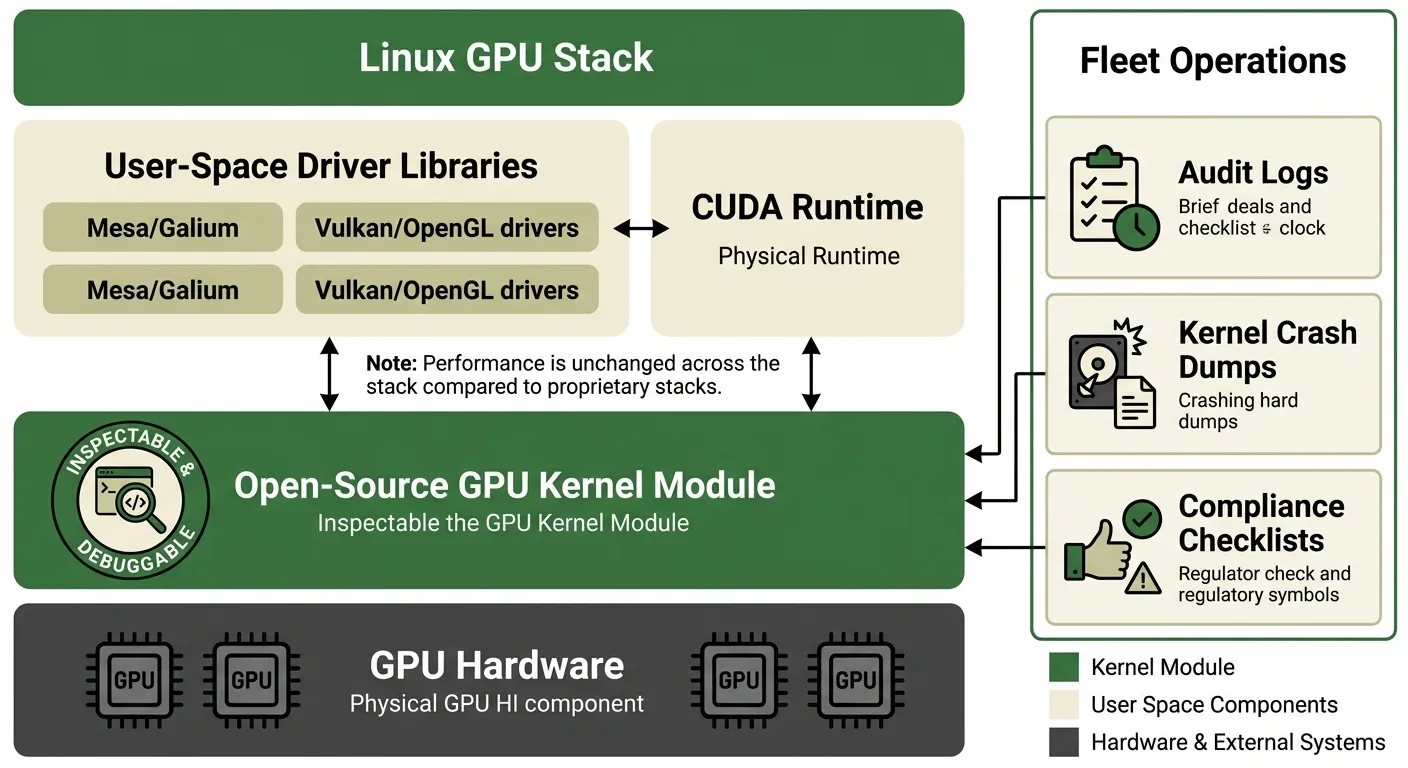
The diagram makes the point visually. Only the box labeled kernel modules changed. Everything above and below it is the same supply chain you had before, which is why the claims about performance and the userspace stack need to stay modest.
What does not change
It is worth being blunt here, because I have watched vendor announcements get paraphrased into internal slide decks that promise things the vendor never said.
Performance. The compute path for a training step lives in your kernels, the CUDA libraries and the hardware. The kernel module handles setup, memory management, scheduling hand-offs and error handling. In steady state it is not on the critical path of your matrix multiplications. Because the kernel module is not on the compute critical path, large differences would be surprising, so measure on your own workloads and treat any difference you see as something to investigate, not a benefit to bank. If someone on your team proposes the migration to speed up training, push back.
The userspace stack. CUDA stays closed. So do cuDNN, cuBLAS and the driver-side compiler pieces. If your concern is the software moat around CUDA, that is a different layer with a different set of alternatives, and swapping the kernel modules does nothing for it. The driver layer and the software layer are separate conversations, and conflating them leads to bad decisions in both.
The firmware. The GSP firmware is still a black box. Moving work onto the GSP is part of why an open kernel driver was feasible at all: the most sensitive hardware-specific logic lives in the firmware rather than in the kernel code. For an auditor that is a real limit. You can inspect what the kernel does with the device, but not everything the device does.
Vendor dependency. You still depend on NVIDIA for the matching userspace driver, the firmware, bug fixes and support. Open source here means you can see and build the kernel layer. It does not mean you can maintain it independently, and I would not plan staffing as though you could.
What does change for operators
Once you accept those limits, the remaining benefits are concrete, and for the right team they are significant.
Debugging a failure you can actually read
When a GPU hits an Xid error, a hang, or a fabric fault, the old workflow was to collect logs, run the vendor bug report script, and send the bundle across the fence. With the open modules, a kernel oops or a lockup in the driver produces a stack trace into source you can open. Tools you already know, such as ftrace, perf, eBPF probes and kprobes, now point at symbols with code behind them rather than opaque objects.
This does not mean your SRE team will start fixing the driver. It means the first hour of triage is more informed. You can tell whether the fault is in memory mapping, in an interrupt path, in power management, or in the interaction with your kernel version. Your escalation to the vendor carries more evidence, and in my experience that shortens the loop more than any support contract tier does.
Building against the kernel you actually run
Teams with custom kernels know the pain. You carry patches for a scheduler tweak, a security hardening set, or a real-time variant, and every new kernel release risks a driver that no longer compiles against it. With a closed kernel interface layer you are limited to NVIDIA’s shim. With source in hand, you can fix a compile break yourself, carry a small local patch while you wait for an upstream fix, and test against release candidates before your fleet is exposed.
Be honest about the cost. Carrying local patches against a vendor driver is a maintenance liability. Every patch needs an owner, a test, and a plan to drop it. I would allow it for build compatibility fixes and treat anything behavioral with deep suspicion.
Audit and compliance
This is where I see the strongest case. Regulated environments, such as financial services, healthcare, defense-adjacent work and sovereign cloud deployments, often require that code running in kernel space be reviewable. Security teams ask a simple question: what is loaded into ring zero on these machines, and can we inspect it? A large closed module has always been an exception that someone had to sign off on, with compensating controls and a recurring review.
The open modules turn part of that exception into something ordinary. You can pin to a specific source revision, build it in your own pipeline, scan it with your usual static analysis, record the hash in your software bill of materials, and show an auditor the exact code. Reproducible builds and signed modules fit naturally into a secure boot flow where you enroll your own key.
Do not oversell this to your compliance lead. The firmware is still opaque, the userspace stack is still closed, and an auditor who reads carefully will notice. The honest framing is that the kernel layer has moved from unreviewable to reviewable, which narrows the exception without eliminating it.
Upstream and ecosystem alignment
Kernel developers have long wanted GPU drivers that fit the normal review and tracing culture of Linux. The open modules are not upstream in the mainline kernel, and I would not assume they will be on any schedule. But they make it easier for distributions, hypervisor vendors and security researchers to examine interactions with things like confidential computing, virtualization and memory management. That is slow, indirect value, and it accrues to everyone eventually, including managed-service customers.
A decision framework
Here is how I would triage the question for a given organization.
You run your own fleet and have compliance or custom-kernel needs. This is the group the change was made for. Plan a migration, define the audit story you want, and invest in the build pipeline. Expect the benefit to show up in incident response and in the next audit cycle.
You run your own fleet without special constraints. The benefit is real but modest. If your hardware is Blackwell, the decision is made for you. If it is Turing through Hopper, move when your normal driver upgrade cadence takes you there, and use the canary process below. There is no reason to rush.
You use a managed GPU service or a hyperscaler’s GPU instances. Your provider owns the driver. You will see little direct benefit, and that is fine. Your provider may build on the open modules and may benefit from them, but you do not choose the driver and you likely cannot inspect it. Ask whether your provider publishes driver versions and change notes. That is the operational information you can actually use.
You are weighing self-hosting against a managed service. Do not let this announcement tip the scale. Self-hosting still makes sense for sustained high utilization, data residency requirements, or specialized hardware tuning. Managed services still make sense when your team cannot staff 24-hour GPU operations or when elasticity matters more than control. An open kernel layer lowers one cost of self-hosting, namely opacity at the lowest level, but it does not erase the others: power, networking, firmware management, spares and people.
Rolling it out without a bad week
If you are in the group that benefits, treat this as the driver migration it is.
- Inventory first. List GPU generations, driver versions and which flavor each node runs. You may find a mixed fleet, and a mixed fleet is a source of confusing bugs.
- Check for unsupported hardware. Anything pre-Turing cannot use the open modules. Plan separately for those nodes rather than discovering the gap mid-rollout.
- Pin the triple. The kernel modules, GSP firmware and userspace driver must come from the same release. Encode that in your image build so they cannot drift apart.
- Canary on real workloads. Run a small slice of nodes through your longest training jobs and your latency-sensitive inference paths. Watch error counters, ECC events, throughput and job restart rates for at least a full cycle of your normal workload mix.
- Test the features you depend on. Multi-instance GPU partitioning, NVLink and NVSwitch fabrics, GPU virtualization, confidential computing modes and persistence settings are where driver differences tend to surface. Validate each one you use, and read the current release notes for known gaps rather than assuming parity.
- Keep a rollback. Where your hardware allows it, keep the proprietary flavor in your image repository for a defined period.
- Instrument for the benefit. Add the tracing and symbol collection you now can, such as keeping debug symbols alongside module builds, so the first real incident pays back the migration effort.
The business view
For a technology leader, the question is whether this changes a budget line or a risk register. Mostly it changes the risk register. It reduces one category of audit exception and one category of vendor opacity for teams that operate their own infrastructure. It might shorten mean time to resolution for driver-level incidents. It does not change your cost per training token, your utilization, your software lock-in at the CUDA layer, or the build-versus-rent decision.
The sensible response is proportionate: assign an owner on the platform team, fold the migration into the next planned driver cycle, brief your security and compliance leads on what is and is not now inspectable, and move on. Do not launch a program. Do not cancel a managed-service contract on the strength of it either.
Where this leaves us
Open kernel modules are a good change that deserves an accurate description. They make one layer of a deep, mostly closed stack readable, buildable and auditable. For a platform team that has spent nights staring at an opaque driver fault, or explaining a kernel exception to an auditor, that is valuable. For a team that rents GPUs by the hour, it is background noise.
The most useful habit is to keep the layers separate in your head and in your planning documents: hardware and firmware, kernel modules, userspace and CUDA, frameworks, workloads. Each has its own openness, its own vendors, and its own tradeoffs. This announcement moved one boundary. Know which one, check whether it is yours, and act accordingly.