· Agentic AI · 12 min read
Agent Memory Layers: When Persistent Memory Beats Re-Retrieval
Agent memory layers pay off only for long-lived agents with repeat users. Use this rule on session length and write rate to decide whether to build one.
In my work with teams shipping agents, the memory conversation usually starts in the wrong place. Someone sees a demo where an assistant remembers a user’s preferences from three weeks ago, and by the next planning meeting there is a ticket titled “add memory layer.” Nobody has asked what the agent forgets today, or whether forgetting costs anyone anything.
I’ve seen this go badly in both directions. One team built a full extraction-and-consolidation pipeline for an agent that ran a single ten-minute task per ticket and never saw the same customer twice. They paid for an LLM call on every write, then spent a quarter debugging stale facts that contradicted the live system of record. Another team refused to build any memory for a support copilot that handled the same fifty accounts all year, and their agents re-asked the same onboarding questions in every session until users quietly stopped using it.
Open-source projects such as vectorize-io’s Hindsight, which treats memory as retain, recall and reflect operations over isolated banks, are making the layer easy to adopt. That is exactly why the decision deserves a rule instead of enthusiasm. A memory layer is not a feature. It is a second data system with its own write path, its own failure modes and its own bill.
- A dedicated memory layer pays off for long-lived agents with repeat users or recurring tasks. For short, one-off tasks it adds staleness risk and write cost with little recall benefit.
- Decide on two numbers: how many sessions the same user or task will see, and how often the agent learns something worth keeping. Low on both means re-retrieve from source.
- Memory is a cache of conclusions, and caches need expiry. Every stored item needs a source, a timestamp and a rule for when it dies.
- For leaders: the cost is not the vector store. It is the extraction calls on every write and the engineering time spent on correctness, so size it against the repeat-user value it unlocks.
Memory versus re-retrieval: what you are really choosing
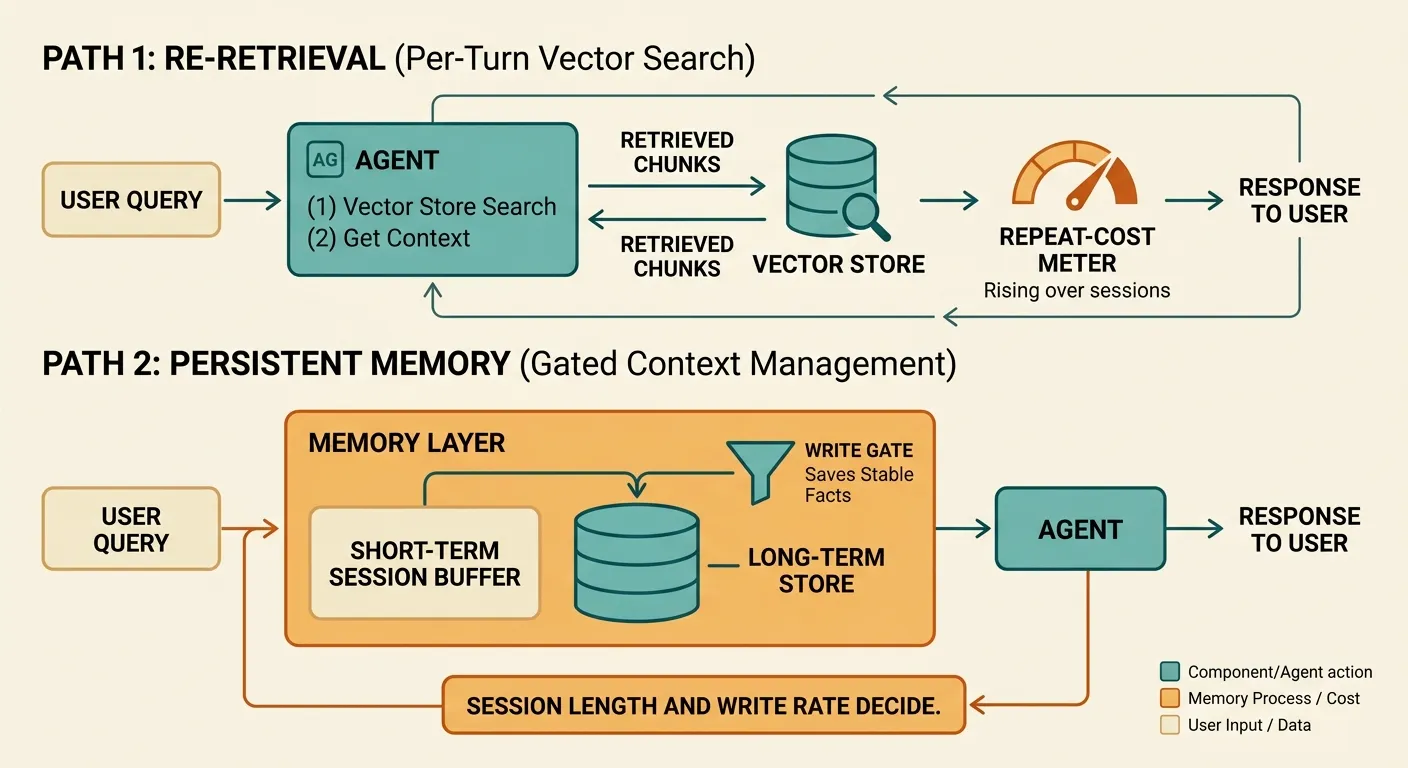
Re-retrieval means the agent starts each session with nothing but its instructions, then pulls what it needs from the systems that already hold the truth: the CRM, the ticket history, the codebase, the document store. Every session pays the lookup cost, and every session sees the current state of the world.
A memory layer is the opposite trade. At write time you spend effort to extract, normalize and index things the agent learned, such as a user’s preferences, a decision made last Tuesday, or the fact that a certain API returns paginated results in a surprising way. At read time recall is cheap and fast, and the agent can use information that exists nowhere else, because it was never written down in any system of record.
Re-retrieval can only find what some other system already stores. Memory earns its keep when the valuable information is an observation made by the agent itself, in conversation, that nobody else recorded.
So the first question is not “vector store or graph?” It is “does this agent produce knowledge that is not already somewhere else, and will it be needed again?” If the answer to either half is no, you are building a slower, staler copy of a database you already have.
The decision rule: session length and write rate
Two variables carry most of the decision. I’ll call them reuse horizon and write rate.
Reuse horizon is how many future sessions will plausibly benefit from what this session learns. A coding agent working a single pull request has a horizon of one. A personal assistant for one executive has a horizon of hundreds. A support agent for a fixed list of enterprise accounts sits in between, with a horizon that depends on how many of those accounts come back.
Write rate is how often a session produces something worth keeping. Many sessions produce nothing durable: the user asked a question, got an answer, and left. Others produce a steady stream of preferences, decisions and corrections.
Combine them and four cases fall out.
| Reuse horizon | Write rate | Verdict |
|---|---|---|
| Short (single task, one-off user) | Low | Skip memory. Re-retrieve from source. |
| Short | High | Use a scratchpad inside the session, discard at the end. |
| Long (repeat users, recurring tasks) | Low | Cheap memory: a small profile or notes file, written by hand or by rule. |
| Long | High | Build the dedicated layer, with lifecycle rules from day one. |
Only the bottom row justifies the full machinery. The third row is the one teams overlook. A user profile of ten fields, updated deterministically, captures most of the value of a memory layer for a fraction of the complexity, and it has no extraction model to drift.
Session length matters in a quieter way. Within one long session, the problem is usually the context window, not persistence. Compaction, summarization and a working scratchpad solve that, and none of them needs a layer that survives the session. I’d call persistent memory a cross-session tool and resist using it to patch in-session context pressure.
As a rough heuristic, and I mean heuristic, not a measured threshold: if you cannot name a user or task that will return at least several times, and a concrete fact the agent would learn on the first visit that it would otherwise have to ask again, do not build the layer yet. Instrument first. Log how often agents re-ask or re-derive the same thing, and let that count make the argument.
What the layer actually costs
The cost people anticipate is storage. It is the smallest line item. The real costs sit elsewhere.
Write-path inference. Systems in this category, Hindsight among them, use a model on retain to pull out facts, entities, timing and relationships before indexing. That is an LLM call per write, sometimes several. It buys better recall, but you pay it whether or not the memory is ever read. For an agent with a low read-to-write ratio, you are funding an archive nobody opens.
Consolidation and reflection. Higher-level memory, such as beliefs synthesized from many observations, needs periodic background work. It adds a second set of inference calls and a second set of things that can be wrong. A summarized belief like “this customer prefers email” is only as good as the observations beneath it.
Evaluation burden. With re-retrieval, you can test the retriever against a fixed corpus. With memory, the corpus is generated by your agent, so a bad extraction poisons later sessions. You need tests that replay conversations and check what was kept, and you need a way to see and correct what the agent believes.
Privacy and governance. Persistent memory about people is personal data with a retention story. Deletion requests, per-user isolation and audit trails stop being optional. Per-user banks or namespaces help, but they are work you now own.
None of this is an argument against memory. It is an argument for pricing it honestly. For a long-lived agent with real repeat users, these costs are usually worth paying, because the alternative is an agent that never improves and keeps asking users to repeat themselves. For a short-task agent, the same costs buy nothing.
Lifecycle: expiry and staleness are the design
Teams treat memory as an append-only log and discover the problem six months later. A memory is a cached conclusion about the world, and the world moves. The right mental model is a cache with invalidation rules, not a notebook.
I’d give every stored item five fields before it is allowed in.
- Source. Where did this come from: a user statement, a tool result, the agent’s own inference? A fact a user stated directly outranks something the agent guessed.
- Timestamp. When it was observed, separate from when it was written. Temporal search over these dates is what lets an agent say “as of March.”
- Confidence or type. Distinguish raw observations from consolidated beliefs. Beliefs should be rebuildable from observations, so you can regenerate them when your logic improves.
- Time to live. Different kinds of facts decay at different rates.
- Verification path. Can the agent check this against a live system before acting on it?
Expiry should follow volatility, not a single global setting. A rough sketch of how I’d tier it:
- Stable preferences (writing style, preferred language, communication channel): long lived, refreshed when the user contradicts them.
- Project and task state (what we decided, what is blocked): weeks, expiring when the project closes or the linked ticket changes status.
- World facts that live in a system of record (account tier, pricing, who owns a service): do not store the value at all. Store a pointer and re-retrieve. This is the single most important rule in this article.
- Ephemeral observations (an error seen once, a transient outage): days at most, or never persisted.
That third bullet is where memory and re-retrieval stop competing and start cooperating. The memory holds what the user told the agent and what the agent concluded. The source systems hold current facts. When the two disagree, the source wins, and the disagreement itself is useful signal: write a correction, lower confidence on the old item, and move on.
Staleness in practice
Here is a failure I’ve watched happen. A sales assistant remembered that a prospect’s procurement contact was a particular person. Eight months later that person had left. The memory was accurate when written, retrieved with high relevance, and wrong. The agent drafted a confident email to someone who no longer worked there. Nothing in the retrieval score could have caught it, because relevance and truth are different properties.
Three habits prevent most of this. First, verify before acting: for any memory that drives an external action, check the live system, or tell the user the fact is from a given date. Second, penalize age in ranking for volatile categories, so old items need stronger evidence to surface. Third, run a periodic sweep that flags items past their time to live and either re-verifies or retires them. The sweep is dull work and it is the thing that keeps the layer trustworthy.
A worked example
Take two agents in the same company.
The first triages inbound IT tickets. Each ticket is a fresh session, the requester varies, and the facts it needs, such as device inventory and access rules, live in existing systems. Reuse horizon is short, and almost nothing it learns is absent from the ticketing system. Verdict: re-retrieve. A memory layer here would copy ticket history into a second store that drifts from the first.
The second is an account copilot assigned to forty enterprise customers, used daily by the same six customer success managers for a year. It learns that one customer’s security team demands a specific document format, that another prefers calls to email, that a rollout was deliberately delayed. None of that is in any CRM field. The horizon is long, the write rate is steady, and users currently repeat themselves every week. Verdict: build the layer, keyed by customer and by manager, with a short time to live on rollout status and a long one on stated preferences.
Same company, same model, opposite answers. The deciding factor was never the technology. It was how often the same context comes back, and whether it exists anywhere else.
Where each side is the better fit
Re-retrieval is the better default when your data is already well organized in systems that stay current, when sessions are independent, or when your risk tolerance for a wrong remembered fact is low, as in regulated advice or anything touching money. It also keeps your system simpler to audit, since there is one source of truth.
A memory layer is the better fit when the agent is meant to relationship-build, improve with use, or carry institutional knowledge that nobody has time to write down. Managed services and open-source options both exist, and the build-versus-adopt choice there depends on your team’s appetite for running another stateful service and your data residency needs. Adopting an open-source layer gets you the extraction and recall pipeline sooner, but the lifecycle rules above remain your responsibility under any option.
For a related look at how the stored structures differ, once you have decided to build, see the comparison of structured memory and vector search. This piece sits upstream of that one: whether to have the layer at all.
What to do on Monday
If you are an engineer, add logging for repeated questions and re-derived facts across sessions for a few weeks. Count how many distinct users or tasks return, and how many facts would have survived to a second session. That data decides the question better than any architecture diagram.
If you lead the team or the budget, ask for the reuse horizon and write rate in the proposal, along with the expiry policy. A memory proposal that cannot state when its items die is a proposal for a future incident. Fund the layer where repeat-user value is clear, and say no, without embarrassment, where the agent’s job ends when the task does.
Memory is worth it for agents that live long and see the same people and problems again and again. For everything else, a good retriever pointed at the real source of truth is cheaper, fresher and easier to trust.