· AI at Scale · 6 min read
Beyond the Monolith - Why the JAX AI Stack is the New Standard for Megakernel Infrastructure
The competitive advantage in AI has shifted from raw GPU volume to architectural efficiency, as the "Memory Wall" proves traditional frameworks waste runtime on "data plumbing." This article explains how the compiler-first JAX AI Stack and its "Automated Megakernels" are solving this scaling crisis and enabling breakthroughs for companies like xAI and Character.ai.

The AI Scaling Crisis: Why Your Infrastructure - Not Your GPUs - Is Slowing Down Innovation
For years, the gold standard in artificial intelligence was a simple management mantra: Scale is all you need. But as we approach 2026, that approach is becoming a strategic liability. Throwing more powerful hardware - specifically more GPUs - at a problem is no longer sufficient. The primary bottleneck today isn’t raw processing power; it’s the sheer inefficiency of the software layer - how data is moved, how memory is managed, and how execution blocks communicate.
We’ve entered the era of Infrastructure-Aware AI, and it demands that leaders look beyond familiar prototyping tools. Companies pioneering the frontier of AI - including xAI, Midjourney, and Character.ai - have recognized this shift and are quietly abandoning traditional monolithic frameworks in favor of the JAX AI Stack. They aren’t chasing academic ease of use; they are focused on winning the efficiency race.
The Hidden Cost of the “Memory Wall”
To understand why a new infrastructure approach is necessary, you must first confront the “Memory Wall.” In traditional deep learning models, execution happens layer-by-layer. Your Python code calls a series of small, individual programs (kernels) to perform basic operations like matrix multiplication or normalization.
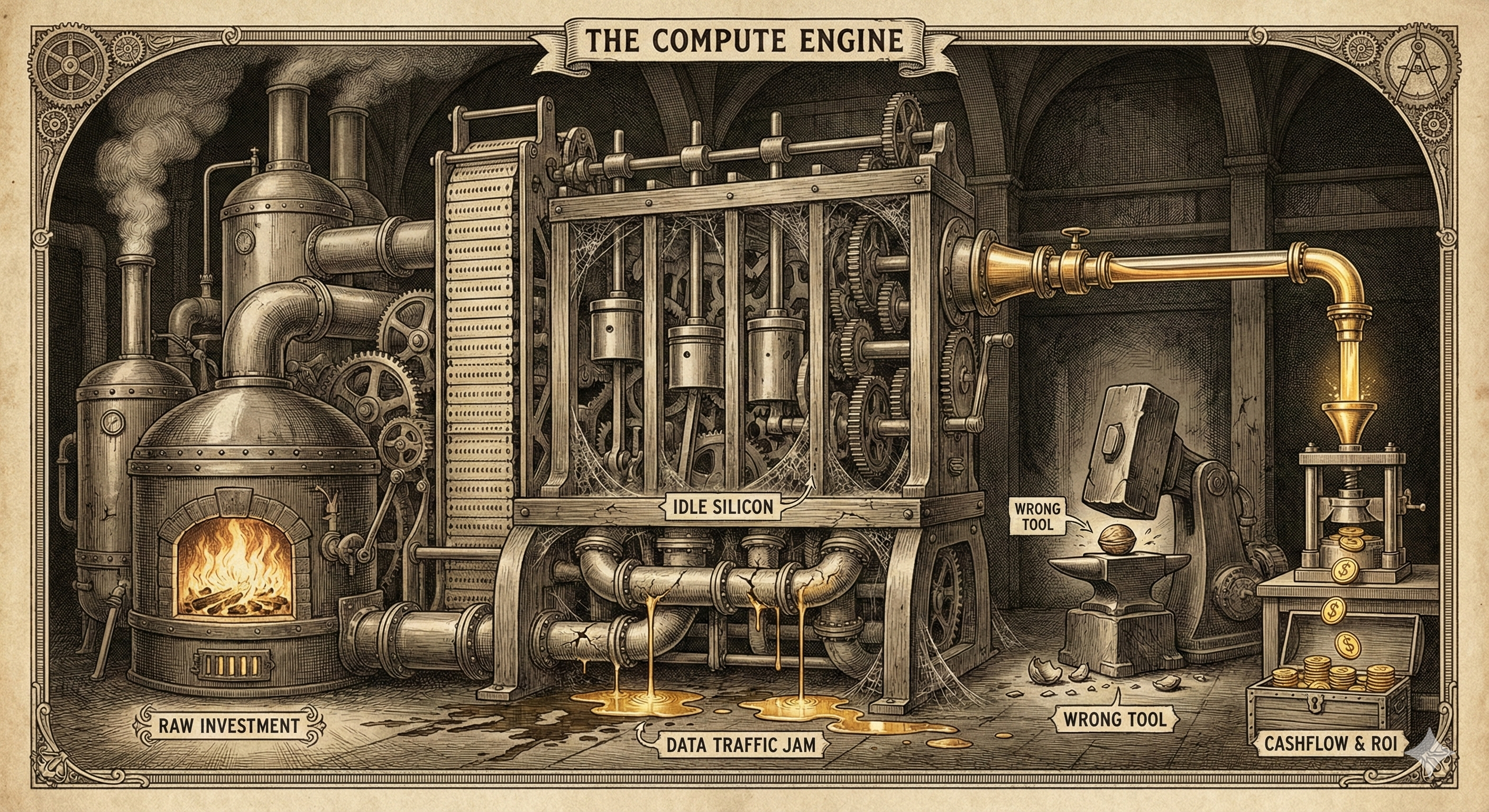
Every one of these small calls requires the hardware to read data from High Bandwidth Memory (HBM), process it, and write it back. As models scale to trillions of parameters, the time spent shuttling data - what experts call “data plumbing” - has begun to eclipse the time spent on actual calculation. A pivotal 2024 study, Data Movement is All You Need, revealed that while matrix multiplications account for 99.8% of operations in a Transformer, they often consume less than 60% of the runtime. The rest is wasted bandwidth, a major financial drain.
This cost crisis has given rise to the Megakernel trend, which fuses massive amounts of computation into single, hardware-optimized execution blocks. Until recently, implementing these high-speed blocks required specialized “wizard” engineers writing complex, low-level code like CUDA. This created an unworkable gap between flexible research code and efficient production systems.
JAX: The Compiler-First Approach to Efficiency
JAX bridges this gap because it’s a compiler-first framework built on XLA (Accelerated Linear Algebra). When you use JAX’s Just-In-Time (JIT) compilation, the compiler automatically examines the entire model graph and fuses operations, creating Automated Megakernels. This automatically yields the massive speedups that previously required specialized, high-cost engineering talent.
For the developer needing even more fine-grained control, Google introduced Pallas in 2025. Pallas allows developers to write custom, high-performance kernels for both TPUs and GPUs directly in Python - providing the low-level performance of specialized code but maintaining the composability and ecosystem benefits of JAX.
The JAX AI Stack isn’t just a library; it’s a modular platform designed for “any-scale” production from a single chip to tens of thousands. Its five core pillars are strategically crucial for business resilience and efficiency:
- JAX Core: Provides the foundation for core computation and essential program transformations like Autograd and JIT.
- Flax & Optax: High-level libraries that bring an organized, object-oriented feel to model building and provide state-of-the-art optimization algorithms.
- Orbax: A distributed checkpointing library providing resilience. When you’re training on 20,000 GPUs, node failure is a daily occurrence; Orbax ensures you don’t lose weeks of expensive compute time.
- Grain: A high-performance, deterministic data loader that prevents the CPU from becoming the costly bottleneck in the training loop.
Strategic Advantages for the Next-Generation Enterprise
Two major industry trends make the JAX stack the logical choice for leaders focused on long-term competitive advantage:
1. Simplified Mixture of Experts (MoE) Scaling
Models like Mistral’s Mixtral 8x7B rely on MoE architectures, where only a fraction of the model is active at any time. Scaling MoE is a nightmare in traditional frameworks due to the complex, dynamic routing across thousands of chips. JAX solves this with GSPMD (General Scalable Parallelism for ML Programs). Developers write code as if it runs on one giant virtual chip, and the compiler intelligently handles the “sharding”. This automated sharding enabled xAI to train the 314-billion-parameter Grok-1 with unprecedented efficiency.
2. Hardware Fungibility and Risk Mitigation
With supply chain volatility affecting NVIDIA H100s and H200s, enterprises are actively seeking alternatives. JAX is the native language of Google’s TPUs (Tensor Processing Units), but the modern JAX stack is hardware-agnostic. The exact same code can run seamlessly on an NVIDIA H100 cluster or a Google TPU v5p pod with zero changes. This fungibility is a critical tool for protecting companies from vendor lock-in and procurement risks.
The Real-World ROI: Case Studies in Efficiency
The strategic shift to JAX is driving significant returns on investment across industries:
- Kakao (LLM Scaling): The South Korean tech giant reported a 2.7x increase in throughput for their production models after migrating to the JAX AI Stack on Cloud TPUs. For a company serving millions, that jump translates into millions of dollars saved in infrastructure costs.
- Lightricks (Generative Video): Building their 13-billion-parameter video generation model, the company found that JAX’s linear scalability allowed them to break through the “scaling wall,” accelerating their training cycles by months.
- Escalante (Scientific AI): Focused on protein design, Escalante leveraged JAX’s unique “composability” - the ability to combine a dozen different models into a single, high-performance optimization loop. They achieved 3.65x better performance per dollar compared to their previous infrastructure, enabling scientific breakthroughs that were previously too cost-prohibitive.
- Character.ai (Inference Optimization): Serving millions of concurrent, persona-rich conversations demands hyper-optimized inference. Built from day one on JAX, the platform’s ability to generate tight, fused kernels for token generation maintains low latency even as their user base rapidly explodes.
The Infrastructure of the Future
If PyTorch is the “Python” of AI - great for quick prototyping and ubiquitous for researchers - then JAX is becoming the industry’s “C++”: the language of high-performance, industrial-scale implementation.
The competitive advantage in 2025 won’t go to the organizations that bought the most chips; it will go to those who can squeeze every last drop of performance from their hardware. The lazy execution models of the past are no longer competitively viable. By embracing the JAX AI Stack, leaders aren’t just adopting a new tool - they are choosing a compiler-first philosophy that treats hardware as a strategic partner, ensuring maximal efficiency and resilience for the next generation of AI systems.